



What key data governance capabilities are included in Operations Hub?
Operations Hub delivers programmable workflow automation, custom code actions, automated contact property formatting, multi-system data sync, and database health scorecards.
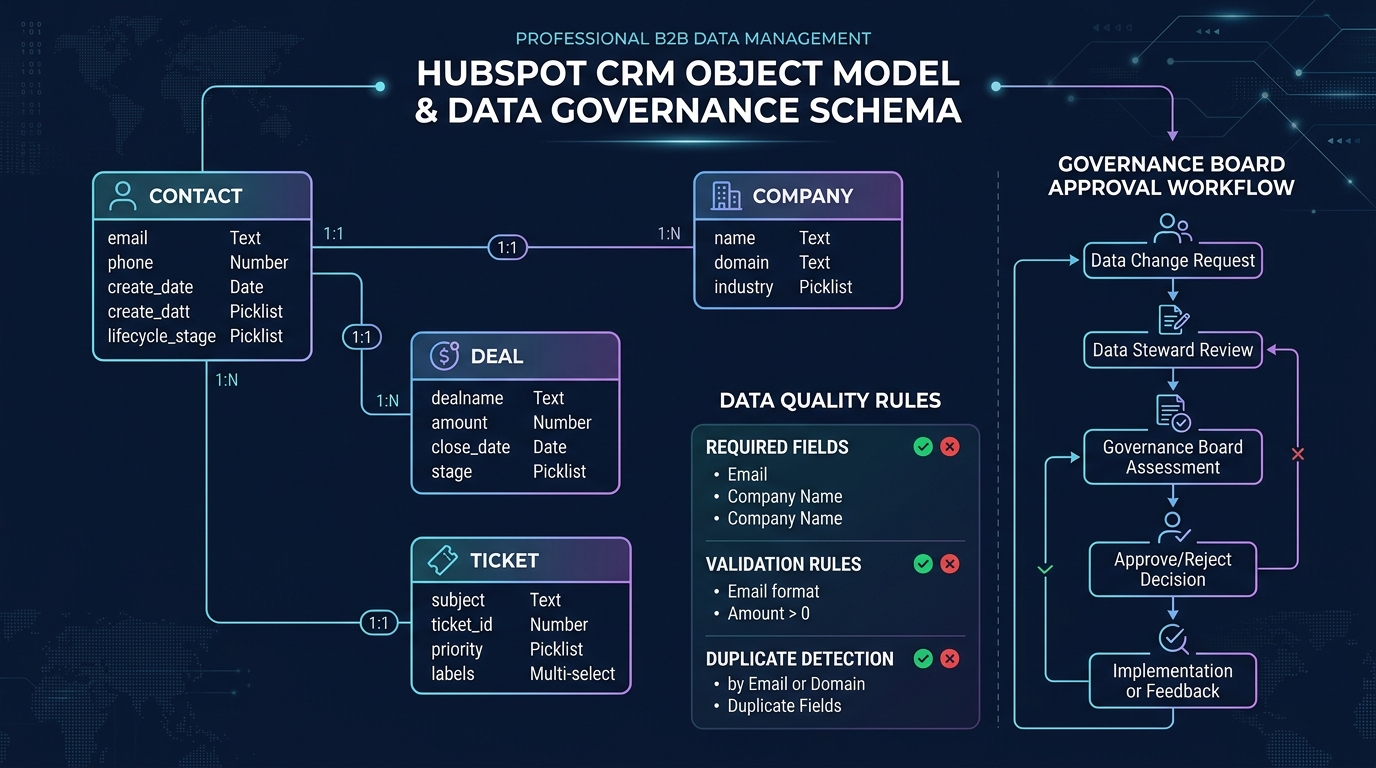
This comprehensive guide provides an operational roadmap designed specifically for Database admins, RevOps architects, and marketing operations leads. We break down step-by-step methodologies, technical schema standards, and actionable frameworks leveraging HubSpot consulting and strategy and revenue operations best practices.
- Foundational data architecture and property schema design determine long-term usability and reporting reliability
- Data governance controls must be established early to prevent quality regression as teams scale
- Process automation should be configured sequentially following a strict dependency matrix
- User enablement requires role-specific training focused on daily high-frequency tasks
- Continuous optimization via quarterly technical reviews ensures sustained ROI and system health
Understanding the Operational Challenge and Strategic Objectives
In modern B2B organizations, executing a successful hubspot data hub: operations hub features and data quality tools represents a critical pivot point for revenue teams.
Before embarking on technical changes, leadership must align on clear business objectives and baseline metrics. HubSpot consulting specialists guide current-state discovery workshops.
To establish accountability across teams, leadership should create a cross-functional steerco comprising representatives from RevOps, sales operations, demand generation, and customer success.
Furthermore, defining clear governance guidelines early prevents scope creep during technical sprints.
Architectural Principles and Property Schema Design
A resilient data architecture relies on standardized property naming conventions, well-defined picklists, and controlled user creation permissions. Uncontrolled property additions create schema clutter that degrades reporting accuracy and user experience over time. A single unconstrained free-text field can introduce hundreds of data variants, making automated lead routing and lifecycle stage transitions unreliable.
When designing property schemas in HubSpot, prioritize dropdown selection fields over unconstrained free-text fields. Free-text inputs inevitably introduce typos and inconsistent values that break list segmentation and workflow triggers. Review HubSpot property types documentation for field constraints and data limits.
Standardizing property groups by team function, such as sales_deal_type, mktg_lead_source, or cs_onboarding_status, ensures that new team members can navigate property settings without creating duplicate fields. Restricting property creation to certified Super Admins maintains portal cleanliness across multi-team deployments.
Furthermore, property architecture must account for historical data preservation. When migrating or restructuring legacy data, map legacy fields to clear archiving properties rather than cluttering active view forms. Maintaining a strict separation between active operational properties and historical reference properties prevents confusion during daily sales outreach and executive pipeline inspections.
Additionally, auditing field level security permissions protects sensitive customer properties. By restricting edit permissions on critical financial, contract, and lifecycle stage properties to designated admin roles, revenue leaders prevent accidental manual overwrites during routine CRM updates.
| Schema Component | Best Practice Rule | Risk of Non-Compliance | Governance Action |
|---|---|---|---|
| Property Naming | Use clear group prefixes (e.g. sales_deal_type) | Property sprawl and duplicate fields | Restrict creation to Super Admins |
| Field Types | Enforce Dropdown Select for picklists | Broken segmentation filters | Convert text fields to picklists |
| Required Fields | Set mandatory fields at key pipeline stages | Incomplete forecast data | Configure stage entry rules |
| Associations | Maintain strict Contact-Company-Deal links | Orphaned records and lost history | Automate primary association rules |
Process Automation and Workflow Dependency Matrix
Automating business processes requires mapping logical dependencies before building enrollment criteria. Workflows designed without clear execution sequencing can trigger conflicting actions, leading to duplicate notifications, overwritten lifecycle stages, or incorrect task assignments.
Always test new workflows in a controlled environment using test records before activating them sitewide. Review HubSpot workflow documentation to understand re-enrollment triggers, delay actions, and execution limits across different subscription hubs.
Establishing a workflow inventory document that records the enrollment triggers, conditional logic branches, and downstream impact of every active workflow minimizes technical debt. When workflows are well-documented, RevOps teams can troubleshoot execution errors within minutes rather than spending hours untangling nested IF/THEN branches.
Additionally, automated workflows should incorporate built-in error handling protocols. For example, if an automated assignment action fails due to an inactive owner ID or missing property value, the workflow should route the record to an unassigned review queue and trigger a Slack or email notification to the RevOps administrator. Proactive error monitoring prevents leads from stalling unobserved in automation bottlenecks.
Workflow execution cadence should also be optimized for system performance. Staggering heavy lead scoring re-computations or daily batch notifications during off-peak hours preserves system responsiveness during peak business hours when sales reps are actively logging activities.
Streamline Your Revenue Operations
Our team of certified HubSpot architects can help evaluate, design, and execute your strategy.
Integration Architecture and Data Synchronization Protocols
Connecting HubSpot to third-party tools such as ERPs, billing engines, enrichment providers, and custom web applications requires clear data flow definitions. Establishing an authoritative system of record for each data object prevents overwrite conflicts during bi-directional synchronization.
For example, financial transaction and subscription billing data should originate in dedicated billing engines and write into HubSpot deal or custom object properties, while contact firmographics originate within HubSpot or connected enrichment tools. Explore HubSpot integration services for complex technical connections.
Monitoring API call volumes, sync error logs, and field mapping transformations protects against silent data sync failures. Setting up automated notifications for integration disconnects ensures technical teams resolve sync breaks before reps experience missing deal or contact updates.
In multi-system architectures, rate-limiting and webhook payload sizes must be optimized. Batching sync updates during off-peak hours for heavy reporting data transfers prevents API throttling, ensuring real-time webhooks for high-priority lead creation actions execute without delay.
Maintaining sandbox sync environments for third-party integrations allows technical teams to test API schema updates and custom webhook payloads without risking production database stability. Comprehensive sandbox testing guarantees zero downtime during third-party platform upgrades.
Data Quality Management and Deduplication Protocols
Maintaining a clean database requires ongoing deduplication and data validation protocols. Duplicate records split engagement history, distort revenue attribution reporting, and frustrate sales reps during prospect outreach.
Implement a multi-pass deduplication strategy: first matching on unique primary email addresses, then on root company domains, and finally conducting manual human reviews for fuzzy name and phone matches. Refer to HubSpot duplicate management tools for built-in remediation features.
Regular automated data health audits ensure that invalid email syntax, unassigned records, and outdated lead statuses are flagged for cleanup. Establishing automated workflows that route unengaged contacts into re-qualification sequences keeps active databases focused on high-intent prospects.
Data enrichment automation can also be integrated into the intake pipeline. By automatically populating company industry, employee headcount, and geographic region upon domain submission, sales reps gain instant context while maintaining uniform picklist values across the portal.
Defining strict data retention and archiving schedules further optimizes database health. Archiving bounce records, unsubscribed contacts, and inactive historical leads reduces contact tier licensing overhead while focusing marketing automation budgets on responsive target audiences.
User Enablement, Training, and Adoption Strategy
System adoption depends on change management rather than software feature availability. Training programs should focus on high-frequency daily tasks tailored to specific user roles rather than overwhelming users with broad feature overviews.
Sales reps need focused training on logging calls, updating deal stages, scheduling meetings, and accessing playbooks, while managers require guidance on pipeline inspection and forecasting. Check HubSpot onboarding services for structured training methodologies.
Sustained adoption is reinforced when sales and marketing leadership conduct regular pipeline reviews directly within HubSpot. When managers inspect deal progress using live portal dashboards rather than offline spreadsheets, team members naturally maintain up-to-date record activities.
To accelerate adoption during the first 30 days, establish a peer champion network. Designating super-users within each sales team to provide peer support creates an immediate feedback loop for usability questions and reduces reliance on helpdesk tickets.
Measuring adoption metrics weekly, such as log-in frequency, activity creation volume, and deal stage modification recency, allows RevOps managers to identify struggling users early and deliver targeted 1-on-1 refresher coaching before bad habits solidify.
Maximize Your HubSpot Investment
Explore our dedicated consulting and custom implementation services tailored for enterprise growth.
Reporting, Dashboards, and Performance Analytics
Executive dashboards provide visibility into revenue health, team productivity, and campaign performance. Designing dashboards around specific decision-making cadences ensures reports drive actionable operational adjustments rather than passive observation.
Build dashboards that track both leading indicators (activity logging frequency, lead response time, sequence conversion rates) and lagging outcomes (close-won rates, average deal size, pipeline velocity). Review HubSpot analytics services for custom reporting setups.
Structuring dashboard views by audience, such as executive board summaries, manager coaching views, and individual rep scorecards, ensures each stakeholder accesses relevant metrics without navigating irrelevant data sets.
Attribution modeling must also be aligned with GTM strategy. Configuring multi-touch attribution models in HubSpot allows marketing leaders to analyze how content assets, paid campaigns, and organic touchpoints contribute to pipeline creation at each buyer journey stage.
Scheduled automated dashboard emails delivered directly to executive inboxes ensure leadership maintains constant visibility into pipeline health without needing to request manual custom reports from RevOps team members.
Long-Term Governance and System Maintenance
Maintaining system health requires establishing a monthly RevOps Governance Board comprising representatives from sales, marketing, customer success, and operations. This board reviews property requests, audits data quality scorecards, and prioritizes feature enhancements.
Conducting quarterly technical audits keeps the portal organized, removes obsolete properties, cleans inactive workflows, and identifies new platform features to adopt. Learn about revenue operations services for ongoing portal maintenance.
As organizations expand into new product lines or geographic regions, governance frameworks provide the scalability needed to add pipeline views, custom objects, and team permissions without compromising core architectural integrity.
Documenting system changes in a centralized change log ensures future RevOps administrators understand the historical rationale behind custom properties, custom code actions, and complex workflow logic, preventing accidental breakage during future portal upgrades.
By combining technical controls, structured documentation, and active steering board governance, revenue organizations maintain a high-performing, reliable CRM platform that supports continuous long-term business growth.
Frequently Asked Questions
What is the primary objective of implementing HubSpot Data Hub?
The primary objective is establishing a streamlined, data-driven revenue engine that accelerates deal velocity, improves data accuracy, and aligns GTM teams. By deploying standardized property schemas, automated workflow logic, and clear pipeline stage rules, organizations eliminate operational friction and gain reliable executive forecasting.
Our HubSpot consulting team guides organizations through structured discovery workshops to align technical configuration with strategic revenue goals. We ensure every custom property, workflow, and dashboard serves a verified operational priority.
How long does a full implementation or optimization project take?
Implementation timelines vary based on database complexity, integration scope, and organizational scale. Standard projects typically range from 6 to 12 weeks, while complex enterprise implementations involving custom integrations, legacy migrations, or multi-hub deployments can span 12 to 16 weeks.
Establishing a phased rollout schedule ensures high-priority sales enablement tools go live early, followed by advanced reporting and custom automation in subsequent sprints. This iterative approach allows teams to realize value quickly while continuing portal refinement.
How do we prevent data corruption and duplicate accumulation during setup?
Data corruption is prevented by enforcing strict property type matching, restricting custom property creation to Super Admins, and staging bulk imports through validated CSV templates. HubSpot import guidelines for detailed technical instructions.
Additionally, executing a multi-pass deduplication pass prior to data ingestion guarantees that legacy duplicates are resolved before records touch live workflows.
Which HubSpot tier is recommended for these capabilities?
Most advanced process automation, custom reporting, sandbox environments, and deal pipeline controls require HubSpot Professional or Enterprise tiers.
We help organizations select licensing that balances budget considerations with operational growth requirements.
How is project ROI evaluated and measured post-launch?
Project ROI is measured by tracking leading indicators (reduced rep administrative time, faster lead response times, higher daily active user adoption) alongside lagging financial outcomes (increased pipeline velocity, higher close-won conversion rates, software consolidation savings). Explore analytics reporting for dashboard configuration.
Establishing baseline metrics prior to project initiation ensures post-launch reporting objectively proves business impact to executive leadership.
How does HubSpot integrate with existing ERP and tech stack applications?
HubSpot connects with external business tools through native App Marketplace integrations or custom API integrations leveraging REST webhooks and developer APIs. HubSpot API documentation for custom integration limits.
Defining authoritative systems of record for each data object prevents sync loops and field overwrite errors across connected platforms.
What change management strategies ensure high sales team adoption?
High adoption is driven by role-specific training sessions focused on daily high-frequency tasks, such as logging meetings, sending sequence templates, and moving deal stages. HubSpot onboarding for structured enablement plans.
Designating peer champions within sales teams provides immediate user support and surfaces usability feedback early during rollout.
What ongoing maintenance is required after project completion?
Ongoing portal maintenance includes conducting monthly data health audits, clearing duplicate records, reviewing workflow execution error logs, and hosting monthly RevOps Governance Board meetings to manage property and pipeline change requests. Learn about revenue operations advisory for ongoing management support.
Quarterly portal audits ensure technical debt is cleaned continuously as new business requirements emerge.
Ready to Transform Your HubSpot Architecture?
Widelly provides end-to-end CRM migrations, revenue operations alignment, and AI agent implementations.
Conclusion
Executing a disciplined approach to hubspot data hub: operations hub features and data quality tools empowers revenue organizations to build a scalable, predictable growth engine. By prioritizing clean data architecture, structured process automation, and active governance, companies unlock the full potential of their HubSpot investment.
Contact Widelly’s certified HubSpot specialists to discuss your specific technical requirements and request a customized scoping proposal.
- HubSpot Knowledge Base: Object Import & Architecture
- HubSpot Knowledge Base: Duplicate Record Resolution
- HubSpot Knowledge Base: Property Type Schema Reference
- HubSpot Knowledge Base: Workflow & Automation Guidelines
- HubSpot Knowledge Base: Pipeline & Stage Configuration
- HubSpot Developer Documentation: REST APIs
About the Author

Charulatha
Expert contributor at Widelly, sharing insights on B2B and B2C growth strategies.
Related Articles

HubSpot vs Salesforce: Honest Comparison for B2B Companies
The Most Common CRM Comparison – Answered Honestly HubSpot and Salesforce are both excellent CRM…

HubSpot Sales Reporting: Pipeline, Forecasting, and Rep Performance
Sales Reporting That Drives Action Sales reports should tell managers what to do, not just…

HubSpot Attribution Reporting: Connect Marketing to Revenue
Attribution Answers the $1M Question: What Marketing Works? Marketing teams spend thousands per month on…