


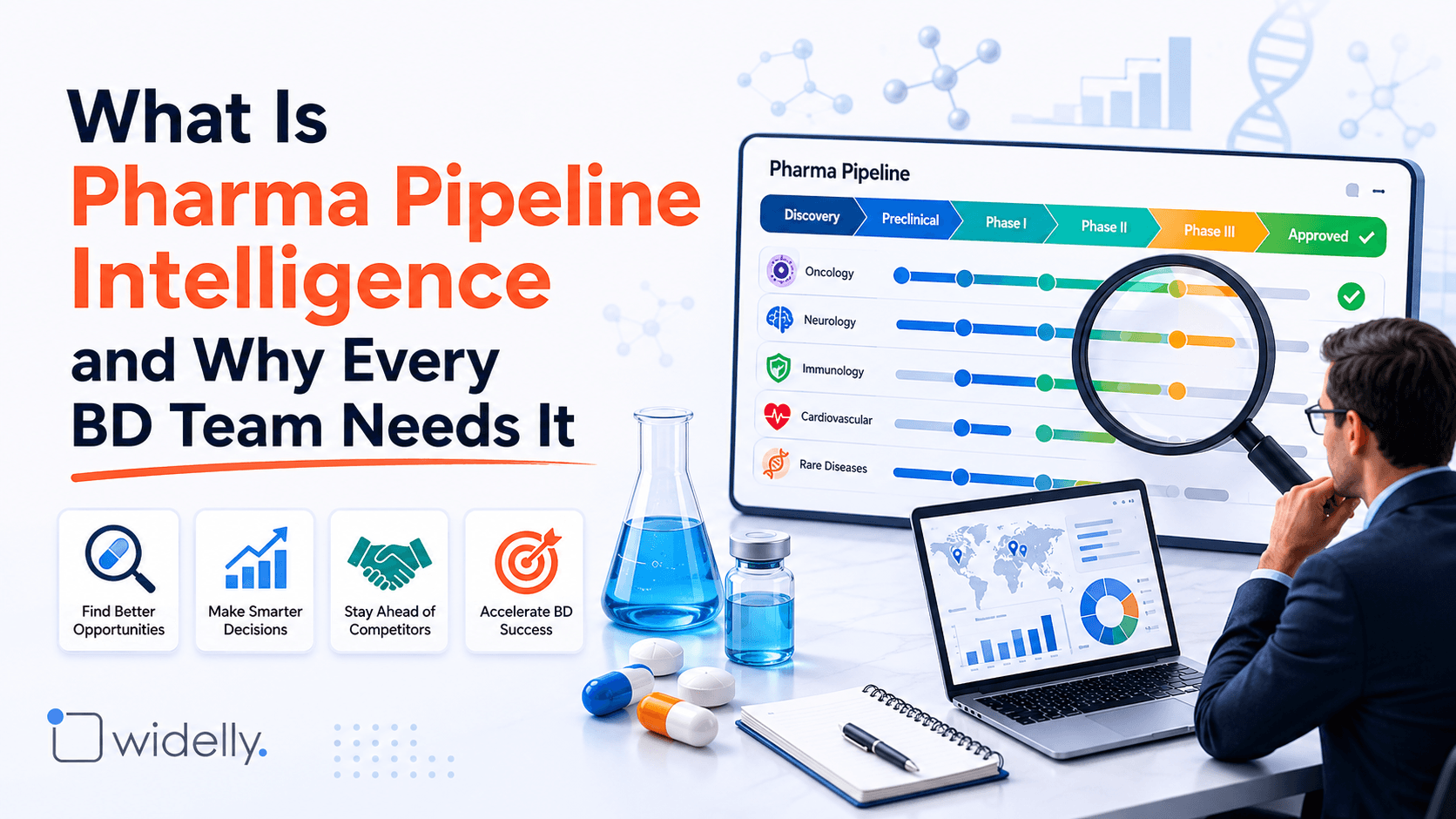
A BD analyst at a mid-size pharma company opens her laptop on Monday morning. She has 14 browser tabs open – ClinicalTrials.gov, three competitor websites, an SEC filing, two news alerts, and a half-updated spreadsheet. By Wednesday, the data she compiled on Monday is already stale.
This is what pipeline research looks like without intelligence infrastructure. It is manual, slow, and reactive. Pharma pipeline intelligence changes that equation. It turns scattered drug development data into structured, actionable insight that BD teams can use to find deals, track competitors, and move faster.
This article explains what pharma pipeline intelligence actually covers, why traditional research methods fall short, and what BD teams gain when they move from manual tracking to systematic intelligence.
The Problem: BD Teams Are Flying Partially Blind
Most BD teams at pharma companies track drug pipelines. However, few do it systematically. The typical workflow involves checking ClinicalTrials.gov periodically, reading analyst reports, and monitoring news feeds. Each source gives a partial view. None of them connect.
The result is a fragmented picture that updates slowly. A competitor moves a compound from Phase 1 to Phase 2, and your team finds out days or weeks later – sometimes from a conference presentation, sometimes from a press release a colleague forwarded.
Manual Research vs. Integrated Pipeline Intelligence
Three specific problems emerge from this approach:
Latency. Manual monitoring creates information gaps measured in days, not hours. In competitive BD, that delay costs opportunities.
Incompleteness. No single analyst can monitor every relevant source. Patent filings, regulatory actions, clinical trial updates, SEC disclosures, and conference abstracts all carry pipeline signals. Most teams track two or three of these consistently.
No prioritization. Raw data does not tell you which pipeline events matter most for your specific therapeutic focus or BD strategy.
The Insight: Pipeline Intelligence Is Not Just Data Collection
Here is what most teams get wrong. They treat pipeline intelligence as a data problem – more sources, more spreadsheets, more alerts. In reality, it is an interpretation problem.
Pipeline intelligence is the practice of systematically collecting, structuring, and analyzing drug development data to generate actionable insights for business decisions. The key word is actionable. A list of Phase 2 compounds is data. Knowing which of those compounds competes directly with your in-licensing target, what their probability of success looks like based on mechanism and indication, and when their next readout is expected – that is intelligence.
The difference matters because it determines what BD teams actually do with the information. Data gets filed. Intelligence gets acted on.
The real insight: Most pharma companies have access to the same public pipeline data. The competitive advantage comes from how quickly and accurately you turn that data into decisions. Companies that treat pipeline intelligence as a workflow – not a report – consistently identify opportunities 2-4 weeks earlier than those relying on periodic research.
Time from Pipeline Event to BD Team Awareness
What Pharma Pipeline Intelligence Actually Covers
Pipeline intelligence spans five core domains. Understanding each one helps BD teams know what to look for and what gaps exist in their current process.
| Domain | What It Tracks | Why BD Teams Need It |
|---|---|---|
| Trial Activity | Phase transitions, enrollment updates, endpoint changes, trial terminations | Identifies competitive moves and in-licensing timing windows |
| Regulatory Signals | IND filings, breakthrough designations, FDA/EMA actions | Flags acceleration or risk in competitor programs |
| IP and Patent Events | Patent filings, expirations, litigation, paragraph IV challenges | Reveals market exclusivity timelines and generic entry risk |
| Deal Activity | Licensing agreements, partnerships, M&A, funding rounds | Maps competitive positioning and available assets |
| Scientific Evidence | Publications, conference presentations, mechanism-of-action data | Validates or challenges clinical hypotheses behind pipeline assets |
Each domain generates signals. The value of pipeline intelligence is connecting signals across domains. A breakthrough designation (regulatory) combined with a new Phase 3 enrollment (trial activity) and a recent partnership announcement (deal activity) tells a much clearer story than any single signal alone.
Decision Intelligence: How to Evaluate Your Pipeline Intelligence Needs
Not every BD team needs the same level of pipeline intelligence. The right approach depends on three factors.
Factor 1: Therapeutic focus breadth. A team focused on one or two therapy areas can often manage with targeted monitoring and periodic deep dives. A team covering five or more areas needs systematic automation – the volume of signals is too high for manual tracking.
Factor 2: Deal velocity. If your company evaluates 5-10 potential deals per year, periodic intelligence may suffice. If you evaluate 30 or more, you need continuous monitoring and structured prioritization, because the cost of missing one signal compounds across the portfolio.
Factor 3: Competitive density. In crowded indications like oncology or immunology, the number of pipeline events per month is high. Sparse indications like rare diseases generate fewer signals but each one carries more strategic weight.
Bottom line: The question is not whether you need pipeline intelligence. It is how much structure and automation your specific situation requires.
| Situation | Recommended Approach |
|---|---|
| 1-2 therapy areas, fewer than 10 deals/year | Structured manual process with quarterly deep dives |
| 3-5 therapy areas, 10-30 deals/year | Semi-automated system with weekly intelligence briefs |
| 5+ therapy areas, 30+ deals/year | Full pipeline intelligence platform with real-time alerts |
The Solution: From Reactive Research to Proactive Intelligence
Moving from manual research to pipeline intelligence involves three shifts.
Shift 1: From periodic to continuous. Instead of checking sources weekly, pipeline events are captured as they happen. This does not mean someone monitors screens all day. It means automated ingestion feeds structured data into a system that flags what matters.
Shift 2: From fragmented to connected. Instead of tracking trials in one tool, patents in another, and deals in a spreadsheet, pipeline intelligence connects all signals to specific drugs, companies, and indications. When a competitor files a new patent, that event links to their active trials and existing partnerships.
Shift 3: From raw data to scored signals. Not every pipeline event deserves attention. Effective intelligence systems score and prioritize events based on relevance to your therapeutic focus, competitive implications, and timing urgency.
The Three Shifts to Pipeline Intelligence
These shifts do not require replacing everything at once. Most teams start with Shift 1 for their highest-priority therapy area and expand from there.
The Value: What BD Teams Gain
Pipeline intelligence delivers measurable improvements in three areas.
Faster opportunity identification. Teams with structured intelligence identify in-licensing opportunities 2-4 weeks earlier than teams relying on manual research. In competitive indications, that window often determines whether you get a first meeting with the asset holder.
Better deal prioritization. When pipeline signals are connected across domains, BD analysts can score and rank opportunities more accurately. Instead of relying on gut feel or incomplete data, decisions are based on a fuller picture of competitive dynamics, regulatory trajectory, and market timing.
Reduced research overhead. BD analysts at companies without pipeline intelligence spend 30-40% of their time on data collection and reconciliation. With structured intelligence, that time shifts to analysis and deal strategy.
According to McKinsey analysis of pharma BD productivity, top-quartile teams spend 60%+ of time on strategic analysis versus data gathering.
Example: How a BD Analyst’s Week Changes
Consider a BD analyst at a 600-person pharma company focused on oncology and immunology. Before pipeline intelligence, her typical week looks like this:
Monday: Check ClinicalTrials.gov for updates on 15 tracked compounds. Update spreadsheet.
Tuesday: Review news alerts. Forward relevant articles to BD director. Cross-reference with trial data.
Wednesday: Pull SEC filings for two competitors. Look for partnership signals.
Thursday: Compile weekly pipeline summary for the BD team meeting.
Friday: Start preparing a landscape analysis for a potential target – realize the trial data she pulled Monday is already outdated.
After implementing structured pipeline intelligence:
Monday: Review automated intelligence brief. Three scored alerts flagged over the weekend – a competitor Phase 2 readout, a new IND filing in her indication, and a licensing deal in a related mechanism. Each alert links to connected signals across trial, regulatory, and deal data.
Tuesday-Thursday: Deep analysis on the flagged opportunities. Prepare evaluation frameworks for two potential targets. Meet with BD director with data-backed recommendations.
Friday: Review updated landscape dashboard. Identify one new company that entered the competitive space last week.
The difference is not just efficiency. It is the quality of insight and the speed of decision-making.
Conclusion
Pharma pipeline intelligence is not a best tool for large enterprises. It is a foundational capability for any BD team that needs to find, evaluate, and act on opportunities in competitive therapeutic areas.
The core principle is simple: turn scattered pipeline data into connected, scored, actionable intelligence. Teams that do this systematically outperform those that rely on manual research – not because they have access to different data, but because they process it faster and connect it better.
If you are building or evaluating your BD intelligence approach, start by mapping the five domains (trial activity, regulatory signals, IP events, deal activity, scientific evidence) against your current monitoring coverage. The gaps you find will tell you exactly where pipeline intelligence adds the most value.
FAQ
What is pharma pipeline intelligence?
Pharma pipeline intelligence is the process of tracking and analyzing drug development activities, including clinical trials, regulatory updates, patents, partnerships, and scientific publications, to help pharma companies make informed business development and competitive strategy decisions.
Why is pipeline intelligence important for pharma BD teams?
Pipeline intelligence helps BD teams identify licensing opportunities earlier, monitor competitors, evaluate therapeutic landscapes, and reduce manual research time through connected data analysis.
What data sources are used in pharma pipeline intelligence?
Common sources include ClinicalTrials.gov, FDA and EMA databases, patent filings, SEC filings, conference abstracts, scientific journals, partnership announcements, and biotech funding reports.
How does AI improve pipeline intelligence?
AI improves pipeline intelligence by automating data collection, identifying patterns across multiple sources, prioritizing relevant signals, and generating real-time competitive insights for BD teams.
What are the main components of pipeline intelligence?
The five main components are:
- clinical trial activity
- regulatory signals
- IP and patent intelligence
- deal and partnership tracking
- scientific evidence monitoring
Related Topics
About the Author

Hamza
Healthcare Market Research and Business Development Specialist with a strong focus on pharmaceutical, biotech, and life sciences sectors. Experienced in analyzing market trends, competitive landscapes, and growth opportunities to support strategic decision-making. Skilled in transforming complex healthcare data into actionable insights that drive business expansion, partnerships, and revenue growth.
Related Articles
How AI Is Changing Clinical Trial Design in 2025
A CMO reviews a Phase 2 protocol. The team has designed a traditional randomized, double-blind,…
China Biotech Licensing Wave: What It Means for Western BD Teams
In 2023, Chinese biotechs signed over $50 billion in total deal value with Western pharma…
Decentralized Clinical Trials: Benefits, Limitations and When to Use Them
During the pandemic, a Phase 3 trial for a cardiovascular drug shifted from 100% site-based…