

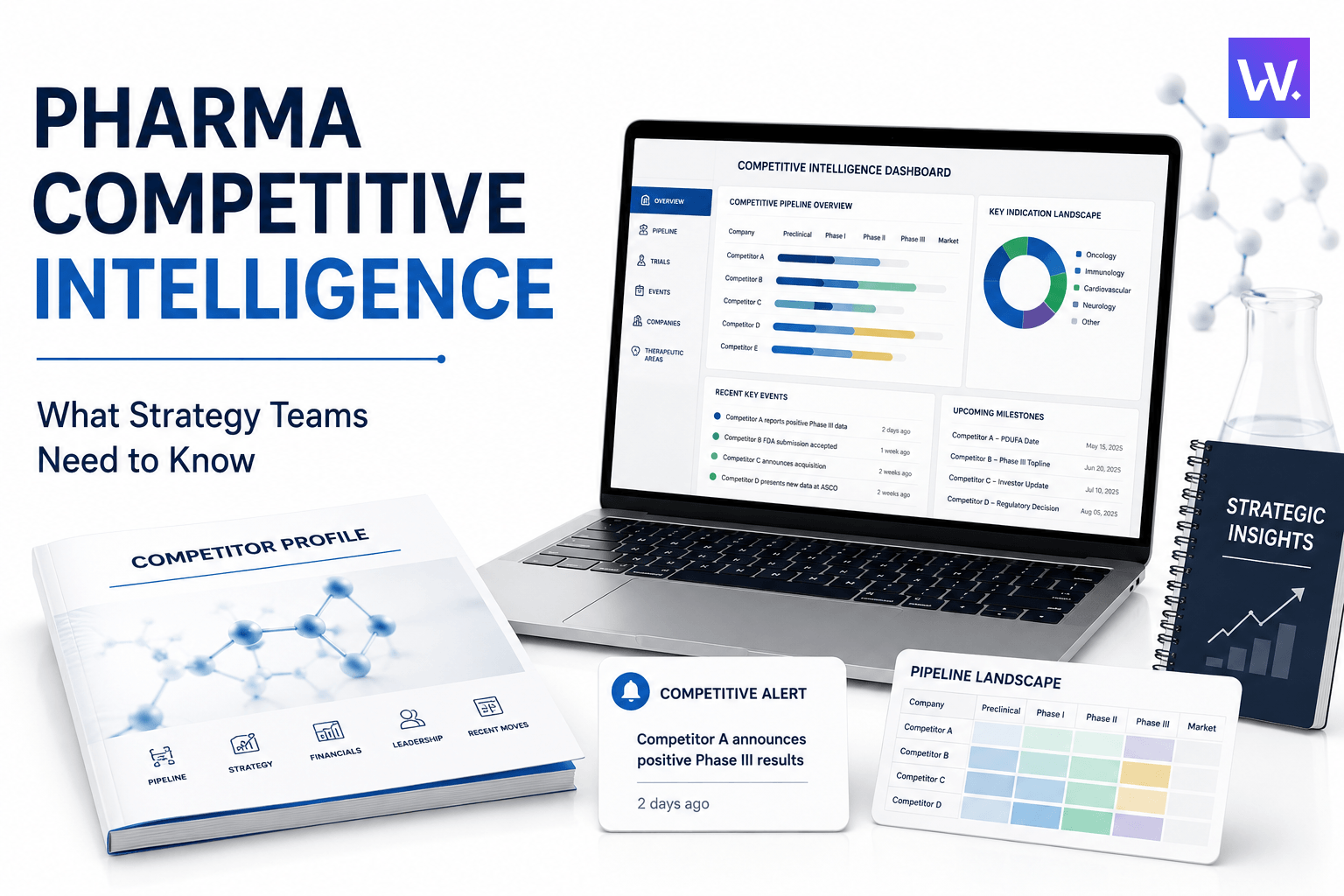
Pharma competitive intelligence is the systematic process of monitoring, analyzing, and interpreting competitor activity to support strategic decision-making.
Most pharmaceutical companies collect competitive information. However, many organizations still rely on ad hoc research requests, disconnected monitoring activities, and fragmented intelligence sources spread across different departments.
The difference between competitive research and competitive intelligence is significant. Competitive research answers questions after they are asked. Competitive intelligence identifies emerging threats and opportunities before they become urgent.
For pharmaceutical companies operating in highly competitive markets, this distinction directly impacts portfolio strategy, business development decisions, clinical planning, launch readiness, and commercial performance.
Organizations with structured competitive intelligence functions consistently identify threats earlier, respond faster, and make more informed strategic decisions than organizations relying on reactive research models.
The Problem: Ad Hoc Competitive Research Cannot Keep Up
Most pharmaceutical companies perform some level of competitor monitoring.
Strategy teams review analyst reports.
Medical affairs teams monitor publications and congress presentations.
Business development teams track acquisitions and licensing deals.
Commercial teams collect field intelligence from physicians and payers.
The problem is that these activities often occur independently.
Each function gathers competitive information. However, very few organizations connect those signals into a unified intelligence picture.
As a result, important competitive patterns frequently go unnoticed.
Common Challenges with Ad Hoc Research
Delayed Detection
Competitive moves often generate multiple signals across different domains.
Clinical trials, conference presentations, hiring activity, acquisitions, and regulatory filings may all indicate a strategic shift.
Without a centralized process, these signals are detected separately rather than interpreted collectively.
Inconsistent Analysis
The quality of analysis often depends on who has available time.
As workloads increase, intelligence quality declines.
No Institutional Memory
Insights frequently remain in presentations, spreadsheets, and email threads.
When employees leave, valuable competitive knowledge often leaves with them.
Consequently, organizations repeatedly answer the same questions rather than building cumulative intelligence capabilities.
What the Evidence Actually Shows
Most pharmaceutical organizations have access to the same publicly available information.
Competitor clinical trials are visible through registries.
Regulatory filings are public.
Conference presentations are accessible.
Investor presentations are published regularly.
The difference is not access to information.
The difference is how information is processed.
Organizations with structured competitive intelligence functions connect signals across multiple domains and convert those signals into strategic insights.
Research from competitive intelligence organizations consistently shows that companies with mature CI functions identify competitive threats months earlier than companies relying on ad hoc research.
In pharmaceutical markets where product launches require years of preparation and hundreds of millions of dollars in investment, even a few months of additional warning can create substantial strategic advantages.
The Insight: Competitive Intelligence Is a Strategic Function, Not a Research Task
Many organizations treat competitive intelligence as a research activity.
When someone needs information, an analyst gathers data and creates a report.
While useful, this approach remains reactive.
A true competitive intelligence function operates differently.
Instead of waiting for questions, intelligence teams continuously monitor competitors, identify emerging patterns, and provide strategic recommendations before decision-makers request them.
The objective is not producing more reports.
The objective is reducing strategic surprises.
Competitive intelligence becomes most valuable when leadership teams use it to anticipate competitor actions rather than explain them after the fact.
What a Pharma Competitive Intelligence Function Actually Produces
A mature CI function generates several categories of intelligence deliverables.
Competitor Profiles
Comprehensive assessments covering:
- Pipeline assets
- Leadership teams
- Financial performance
- Strategic priorities
- Recent business development activity
These profiles provide a foundation for ongoing monitoring.
Pipeline Landscapes
Pipeline landscapes compare competitor assets by:
- Indication
- Development stage
- Mechanism of action
- Regulatory status
These assessments help teams understand evolving competitive environments.
Competitive Alerts
Real-time notifications covering:
- Clinical trial results
- Regulatory decisions
- Licensing transactions
- Acquisitions
- Product launches
Alerts ensure stakeholders receive timely updates.
Battlecards
Battlecards provide concise competitor summaries for:
- Sales teams
- Medical affairs teams
- Market access teams
They support field-level competitive engagement.
Strategic Early Warnings
These represent the highest-value CI deliverables.
Early warning reports identify emerging patterns that suggest future competitor actions before public announcements occur.
Decision Intelligence: Does Your Organization Need a Formal CI Function?
Not every organization requires a dedicated competitive intelligence department.
However, organizational complexity often determines when formal capabilities become necessary.
Ad Hoc Research Model
Typical characteristics:
- No dedicated CI staff
- Research performed on request
- Limited monitoring
- Minimal institutional knowledge
This approach works for smaller organizations.
Formal CI Function
Typical characteristics:
- Dedicated analysts
- Structured reporting cadence
- Centralized monitoring
- Cross-functional intelligence sharing
This model supports growing pharmaceutical organizations.
Advanced CI Programs
Characteristics include:
- Dedicated intelligence teams
- Automated monitoring tools
- AI-assisted signal detection
- Predictive intelligence models
These programs often support global pharmaceutical organizations with multiple therapeutic areas.
The Value: What Changes When CI Becomes Strategic
Organizations that invest in competitive intelligence often experience measurable improvements.
Faster Response Times
Competitive developments are identified and distributed more quickly.
Fewer Strategic Surprises
Leadership teams gain earlier visibility into emerging threats.
Better Launch Preparation
Commercial teams can adjust positioning before competitor actions occur.
Improved Portfolio Decisions
Clinical and business development teams gain stronger visibility into future market dynamics.
Ultimately, CI improves decision quality by reducing uncertainty.
Example: The Competitive Surprise That Changed Everything
A mid-sized pharmaceutical company prepared to launch a therapy for moderate-to-severe psoriasis.
Launch planning assumed two primary competitors.
Six weeks before launch, a competitor announced a label expansion into the same patient population.
The expansion included superior secondary endpoint data and significantly strengthened the competitor’s commercial position.
The consequences were immediate.
The commercial team revised messaging.
Sales training materials required updates.
Pricing assumptions changed.
The launch timeline slipped by three months.
Estimated first-year revenue impact exceeded $40 million.
Post-event analysis revealed that warning signals existed months earlier.
Competitor trial designs, conference activity, and KOL engagement patterns all suggested the possibility of a label expansion.
However, these signals remained isolated across multiple functions.
No team connected them.
Following the launch disruption, the company established a dedicated three-person CI function.
Within the first year, the team identified multiple competitive developments early enough to influence commercial planning.
How to Build a Pharma Competitive Intelligence Function
Successful CI programs begin with clear scope and stakeholder alignment.
Define Scope
Determine:
- Which competitors matter
- Which therapy areas matter
- Which decisions CI should support
Without scope, intelligence efforts become unfocused.
Identify Stakeholders
CI outputs should serve:
- Strategy teams
- Business development
- Clinical development
- Commercial leadership
- Executive leadership
Stakeholder needs determine intelligence priorities.
Select Tools
Most CI programs require:
- Pipeline databases
- News monitoring platforms
- Regulatory monitoring
- Knowledge management systems
Technology supports efficiency but does not replace analysis.
Establish Reporting Cadence
Effective CI programs often include:
- Weekly intelligence briefings
- Monthly landscape reviews
- Quarterly competitor assessments
Consistency builds trust and adoption.
CI Output Formats That Actually Drive Decisions
The most effective CI teams tailor outputs to stakeholder needs.
For Business Development Teams
A monthly deal intelligence report covering:
- Licensing activity
- M&A signals
- Funding events
- Partnership opportunities
For Clinical Teams
A quarterly pipeline threat assessment covering:
- Competing trials
- Emerging mechanisms
- Regulatory milestones
For Commercial Teams
Launch readiness intelligence covering:
- Pricing strategies
- Positioning approaches
- Market access developments
The best CI outputs answer decision questions rather than simply summarize information.
Five Signs Your CI Function Is Underperforming
Your CI capability may require improvement if:
- Stakeholders learn competitor news from LinkedIn before internal alerts.
- CI reports are rarely referenced in strategy meetings.
- Analysts spend most of their time collecting data rather than interpreting it.
- The same intelligence requests repeatedly occur across departments.
- Leadership cannot identify strategic decisions influenced by CI outputs.
These symptoms often indicate a need for stronger processes, tooling, or stakeholder alignment.
How Competitive Intelligence Creates Advantage at Deal Speed
In licensing and acquisition environments, information asymmetry creates value.
Organizations that identify competitor interest earlier can make better decisions regarding:
- Deal timing
- Asset valuation
- Negotiation strategy
- Resource allocation
For example, intelligence signals may indicate:
- Competitor conference activity
- Regulatory milestone timing
- Pipeline prioritization changes
- Increased business development activity
These signals often influence deal outcomes long before formal announcements occur.
Consequently, competitive intelligence frequently becomes a strategic advantage during transactions.
CI Team Metrics Worth Tracking
High-performing CI functions monitor several key metrics.
Alert Speed
Average time between a competitor event and stakeholder notification.
Target: Under 24 hours for major events.
Stakeholder Engagement
Percentage of stakeholders actively using CI outputs.
Early Threat Detection
Number of significant competitive developments identified before public announcements.
Strategic Impact
Number of major decisions influenced by CI insights.
These metrics help demonstrate business value and support continuous improvement.
Conclusion
Pharma competitive intelligence is far more than competitor monitoring.
It is the systematic process of converting competitive information into strategic insight.
Organizations relying solely on ad hoc research often react to competitor moves after they occur.
Organizations with structured CI functions identify threats earlier, respond faster, and make better-informed decisions.
As pharmaceutical markets become increasingly competitive, the cost of operating without formal competitive intelligence continues to grow.
The question is no longer whether competitor information exists.
The question is whether your organization can identify, interpret, and act on that information before competitors do.
For strategy leaders, business development teams, clinical organizations, and commercial executives, that capability has become a significant source of competitive advantage.
Frequently Asked Questions
What is pharma competitive intelligence?
Pharma competitive intelligence is the systematic process of monitoring, analyzing, and interpreting competitor activities, market developments, clinical programs, and regulatory events to support strategic decision-making.
How is competitive intelligence different from market research?
Market research focuses on customers, physicians, patients, and market demand. Competitive intelligence focuses on competitors, pipelines, strategic moves, and external threats.
What are the primary data sources for pharma CI?
Common sources include ClinicalTrials.gov, FDA and EMA filings, conference presentations, investor communications, press releases, pipeline databases, and expert interviews.
Why is competitive intelligence important in pharmaceutical companies?
Competitive intelligence helps organizations identify threats earlier, improve launch readiness, support business development decisions, and reduce strategic surprises.
What does a competitive intelligence team do?
A CI team monitors competitors, analyzes market developments, produces intelligence reports, issues alerts, supports strategic planning, and provides decision-makers with actionable insights.
How many people are needed for a CI function?
Smaller organizations may operate with one or two dedicated analysts. Larger pharmaceutical companies often maintain teams of four to eight specialists supported by technology platforms.
What metrics should a competitive intelligence function track?
Important metrics include alert speed, stakeholder engagement, early threat detection rates, and the number of strategic decisions influenced by CI outputs.
How does competitive intelligence support business development?
CI helps identify acquisition targets, licensing opportunities, competitive threats, valuation risks, and emerging market shifts that influence transaction strategy.
Related Topics
About the Author

Hamza
Healthcare Market Research and Business Development Specialist with a strong focus on pharmaceutical, biotech, and life sciences sectors. Experienced in analyzing market trends, competitive landscapes, and growth opportunities to support strategic decision-making. Skilled in transforming complex healthcare data into actionable insights that drive business expansion, partnerships, and revenue growth.
Related Articles
How AI Is Changing Clinical Trial Design in 2025
A CMO reviews a Phase 2 protocol. The team has designed a traditional randomized, double-blind,…
China Biotech Licensing Wave: What It Means for Western BD Teams
In 2023, Chinese biotechs signed over $50 billion in total deal value with Western pharma…
Decentralized Clinical Trials: Benefits, Limitations and When to Use Them
During the pandemic, a Phase 3 trial for a cardiovascular drug shifted from 100% site-based…