


Drug patents are among the most misunderstood aspects of pharmaceutical business development.
A compound may be described as “protected until 2035,” yet the most commercially important patent may expire years earlier. Likewise, regulatory exclusivity and patent protection are often confused despite being separate systems with different legal and commercial implications.
For business development teams, strategy professionals, investors, and portfolio analysts, understanding drug patent basics is essential. Patent protection influences asset valuation, licensing negotiations, competitive intelligence, and long-term revenue forecasts.
This article explains the major patent types used in pharmaceutical development, how patent life works, the difference between patent protection and regulatory exclusivity, and how to evaluate patent landscapes without a legal background.
Problem: Patent Misunderstandings Lead to Bad Deal Decisions
A BD director evaluates a licensing opportunity.
The partner claims the asset is protected until 2035. The date is included in valuation models and licensing forecasts.
Months later, IP due diligence reveals a different story.
The compound patent expires in 2029. The 2035 date refers to a formulation patent with limited scope that competitors could potentially design around.
This scenario is surprisingly common.
Three misunderstandings cause most patent-related valuation mistakes.
Confusing Patent Types
Not all patents provide the same level of protection.
A compound patent offers fundamentally different protection than a formulation patent or a method-of-use patent.
Confusing Patent Life with Market Exclusivity
Patent protection and regulatory exclusivity are separate systems.
In some cases they overlap. In other cases they do not.
Assuming a Single Expiry Date
Most commercial drugs are protected by multiple patents.
As a result, patent protection rarely ends on a single date. Instead, protection gradually declines over time.
For business development teams, these misunderstandings can significantly distort asset valuations and revenue projections.
What the Evidence Actually Shows
Many pharmaceutical assets appear more protected than they actually are.
This occurs because companies frequently highlight the latest-expiring patent in presentations and data rooms. However, not every patent contributes equally to commercial exclusivity.
Historically, compound patents provide the strongest barrier to generic entry because they protect the active ingredient itself.
Secondary patents—including formulation, process, and method-of-use patents—may still create value, but they often provide narrower protection and can sometimes be challenged or designed around.
Consequently, the most important question is not:
“When does the last patent expire?”
Instead, the better question is:
“Which patent actually prevents meaningful competition?”
Understanding this distinction dramatically improves licensing evaluations, acquisition analysis, and competitive assessments.
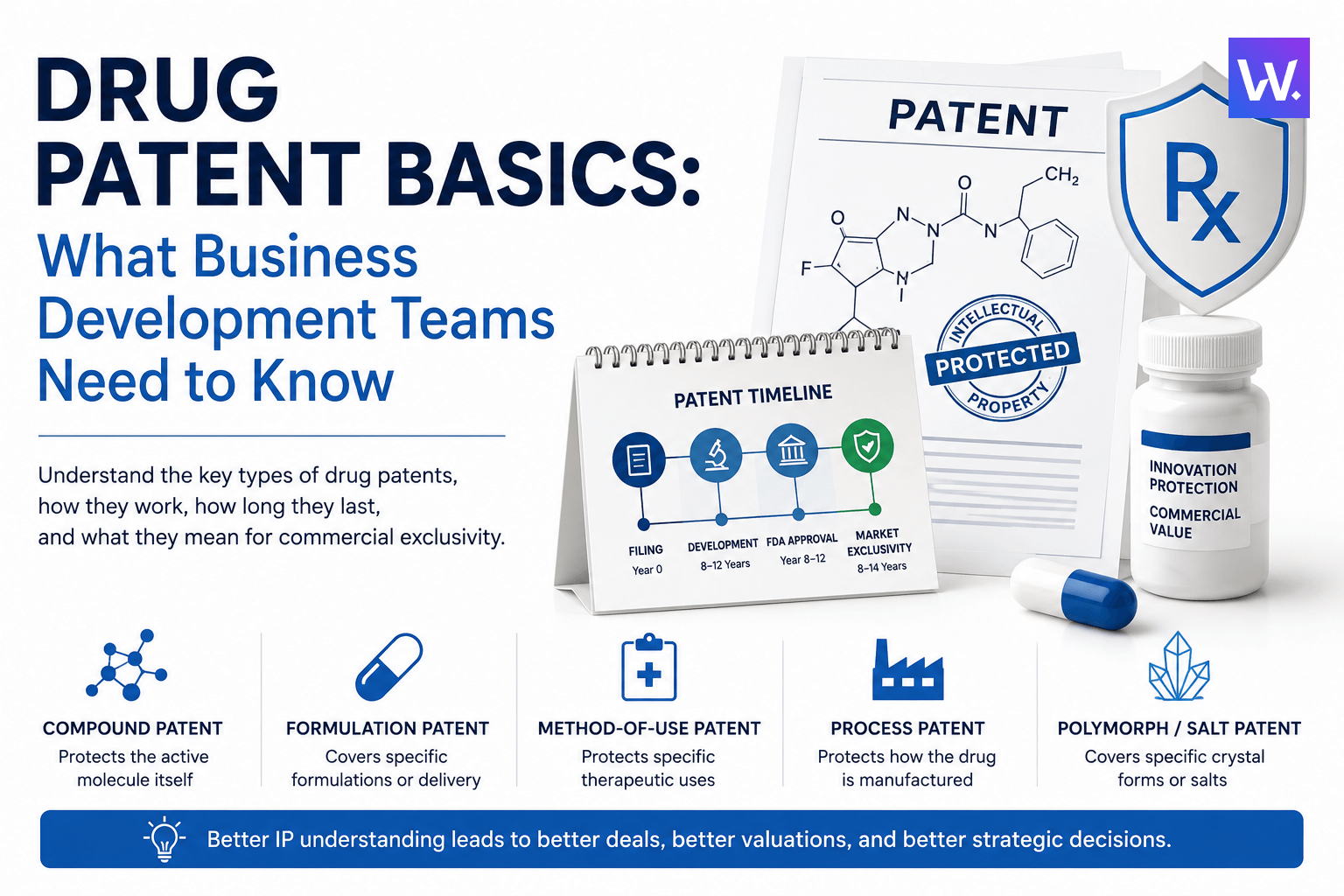
The Five Drug Patent Types Every BD Team Should Understand
1. Compound Patent (Composition of Matter)
This patent protects the active molecule itself.
It is generally considered the strongest form of pharmaceutical patent protection.
As long as a valid compound patent remains in force, competitors cannot legally make, use, or sell the molecule.
2. Formulation Patent
Formulation patents protect specific delivery methods or formulations.
Examples include:
- Extended-release tablets
- Injectable formulations
- Combination products
While valuable, formulation patents often provide narrower protection than compound patents.
3. Method-of-Use Patent
These patents protect a specific therapeutic use.
For example:
- Treatment of a specific disease
- Particular dosing regimens
- Defined patient populations
Method-of-use patents often support lifecycle management strategies.
4. Process Patent
Process patents protect manufacturing methods.
However, competitors may be able to develop alternative manufacturing approaches.
As a result, process patents are generally considered weaker barriers to entry.
5. Polymorph or Salt Patents
These patents protect specific crystal structures or salt forms of a drug.
Their commercial importance depends heavily on whether alternative forms remain available.
Patent Strength Comparison
| Patent Type | What It Protects | Strength | Generic Risk |
|---|---|---|---|
| Compound Patent | Active ingredient | Strongest | Low until expiry |
| Formulation Patent | Delivery method | Moderate | Can be designed around |
| Method-of-Use Patent | Specific indication | Moderate | Skinny-label risk |
| Process Patent | Manufacturing process | Weak | Alternative processes possible |
| Polymorph / Salt Patent | Crystal structure | Variable | Depends on alternatives |
The key takeaway is simple:
Compound patents matter most.
Many secondary patents create value, but few provide the same level of protection.
How Drug Patent Life Works
Many professionals assume patents provide 20 years of market exclusivity.
That assumption is incorrect.
Patents last 20 years from filing, not from approval.
Unfortunately, drug development consumes much of that period.
A typical timeline looks like this:
Patent Filing
The 20-year patent clock begins.
Clinical Development
Clinical testing and regulatory review typically consume 8–12 years.
FDA Approval
The product finally reaches market.
Patent Term Extension (PTE)
A portion of lost development time may be restored through Patent Term Extension.
Commercial Exclusivity
The remaining effective exclusivity period often ranges from 8–14 years.
Therefore, effective patent life is often much shorter than many non-IP professionals expect.
Patent Term Extension: Why It Matters
Patent Term Extension (PTE) exists because pharmaceutical companies lose significant patent life during clinical development.
In the United States:
- Up to 5 years can be restored
- Only one patent typically qualifies
- Total post-approval patent life cannot exceed 14 years
Consequently, PTE frequently becomes one of the most important variables in exclusivity forecasting.
Patent Protection vs Regulatory Exclusivity
One of the most important concepts in pharmaceutical strategy is understanding that patents and regulatory exclusivity are separate systems.
Patent Protection
Granted by patent authorities.
Prevents competitors from making, using, or selling an invention.
Regulatory Exclusivity
Granted by regulators such as the FDA.
Prevents competitors from relying on originator data.
The two protections often overlap.
However, they do not always expire simultaneously.
| Protection Type | Duration | Source | Primary Effect |
|---|---|---|---|
| NCE Exclusivity | 5 Years | FDA | Blocks generic submissions |
| Orphan Drug Exclusivity | 7 Years | FDA | Blocks same indication competition |
| Biologic Exclusivity | 12 Years | FDA | Blocks biosimilar approval |
| Pediatric Exclusivity | +6 Months | FDA | Extends existing protections |
| Patent Protection | 20 Years from Filing | USPTO | Blocks making, using, selling |
In practice, whichever protection lasts longer often determines effective exclusivity.
How to Read a Drug Patent Landscape
Business development professionals do not need a law degree to evaluate basic patent risk.
However, they should follow a structured process.
Step 1: Identify the Compound Patent
Determine the filing date and expected expiration date.
This is usually the most important patent.
Step 2: Check for Patent Term Extension
Determine whether additional protection was granted.
Step 3: Review Secondary Patents
Map:
- Formulation patents
- Method-of-use patents
- Process patents
- Device patents
Step 4: Check the FDA Orange Book
Review listed patents and exclusivities.
Step 5: Look for Paragraph IV Challenges
Active Paragraph IV filings often indicate generic manufacturers believe they can challenge existing patents.
This can significantly affect commercial forecasts.
The Value of Patent Literacy for BD Teams
Patent literacy creates advantages throughout the deal lifecycle.
Better Due Diligence
Understanding patent types prevents overestimating exclusivity.
Better Valuation Models
Forecasts become more realistic.
Better Deal Structures
Milestones and royalties can be aligned with actual exclusivity windows.
Better Competitive Intelligence
Patent filings often provide early warning signals about future competition.
Example: Why Two Patent Dates Created Two Different Valuations
A BD team evaluates an oral diabetes therapy.
The company claims protection until 2032.
Further investigation reveals:
- Compound patent expires in 2028
- Formulation patent expires in 2032
- Two generic manufacturers have already submitted Paragraph IV challenges
The formulation patent protects only a specific extended-release version.
Generic competitors may still launch immediate-release versions after 2028.
As a result:
The realistic exclusivity period is closer to 2028–2029 than 2032.
This four-year difference changes projected net present value by approximately 30%.
The patent dates did not change.
The interpretation did.
How Pharma Companies Manage Patent Portfolio Risk
Large pharmaceutical companies rarely rely on a single patent.
Instead, they build patent portfolios containing multiple overlapping protections.
Common approaches include:
- Additional formulations
- New indications
- New dosing regimens
- Manufacturing innovations
- Device combinations
- Patient subgroup claims
This approach creates a patent thicket that makes competition more difficult and more expensive.
The objective is not simply extending protection.
The objective is increasing uncertainty for potential competitors.
What Pharma BD Professionals Need to Know About IP Due Diligence
Every licensing opportunity should answer three critical questions.
Freedom to Operate
Can the asset be commercialized without infringing third-party patents?
Validity Risk
How likely are the patents to survive future challenges?
Ownership Risk
Does the licensor actually control the intellectual property?
These questions frequently have more valuation impact than the patent expiry date itself.
Conclusion
Drug patents come in multiple forms, but not all patents provide equal protection.
Compound patents remain the strongest barrier to generic competition, while formulation, method-of-use, process, and polymorph patents often provide narrower protection.
For business development professionals, the most important skill is distinguishing between core patents and secondary patents when evaluating commercial exclusivity.
Patent life, regulatory exclusivity, patent term extension, and litigation activity all influence the actual revenue protection period.
Organizations that understand these dynamics make better licensing decisions, perform stronger due diligence, and build more accurate valuation models.
In pharmaceutical business development, understanding patent basics is not simply an IP exercise.
It is a strategic advantage.
Frequently Asked Questions
How long does a drug patent last?
A pharmaceutical patent generally lasts 20 years from the filing date. However, because drug development often consumes 8–12 years, effective market exclusivity is usually much shorter.
What is the difference between a compound patent and a method-of-use patent?
A compound patent protects the active molecule itself and provides the strongest protection. A method-of-use patent protects a specific therapeutic application of that molecule.
What is Patent Term Extension (PTE)?
Patent Term Extension restores a portion of the patent life lost during regulatory review and clinical development. In the United States, PTE can add up to five years of additional protection.
What is a Supplementary Protection Certificate (SPC)?
An SPC is the European equivalent of Patent Term Extension. It can extend protection for up to five years beyond the original patent expiry date.
What is an Inter Partes Review (IPR)?
An IPR is a legal process used to challenge patent validity before the U.S. Patent Trial and Appeal Board. Generic companies frequently use IPRs to challenge pharmaceutical patents.
Can method-of-use patents stop generic competition?
Not completely. Generic manufacturers can sometimes use carve-out labels that exclude patented indications while marketing the product for other approved uses.
What is biologic data exclusivity?
The FDA grants biologics 12 years of regulatory exclusivity. During this period, biosimilar manufacturers cannot rely on the originator’s clinical data.
Why is patent literacy important for business development teams?
Patent literacy helps BD professionals perform better due diligence, build more accurate valuation models, structure deals more effectively, and avoid costly exclusivity assumptions.
Related Topics
About the Author

Hamza
Healthcare Market Research and Business Development Specialist with a strong focus on pharmaceutical, biotech, and life sciences sectors. Experienced in analyzing market trends, competitive landscapes, and growth opportunities to support strategic decision-making. Skilled in transforming complex healthcare data into actionable insights that drive business expansion, partnerships, and revenue growth.
Related Articles
How AI Is Changing Clinical Trial Design in 2025
A CMO reviews a Phase 2 protocol. The team has designed a traditional randomized, double-blind,…
China Biotech Licensing Wave: What It Means for Western BD Teams
In 2023, Chinese biotechs signed over $50 billion in total deal value with Western pharma…
Decentralized Clinical Trials: Benefits, Limitations and When to Use Them
During the pandemic, a Phase 3 trial for a cardiovascular drug shifted from 100% site-based…