


Executive Summary
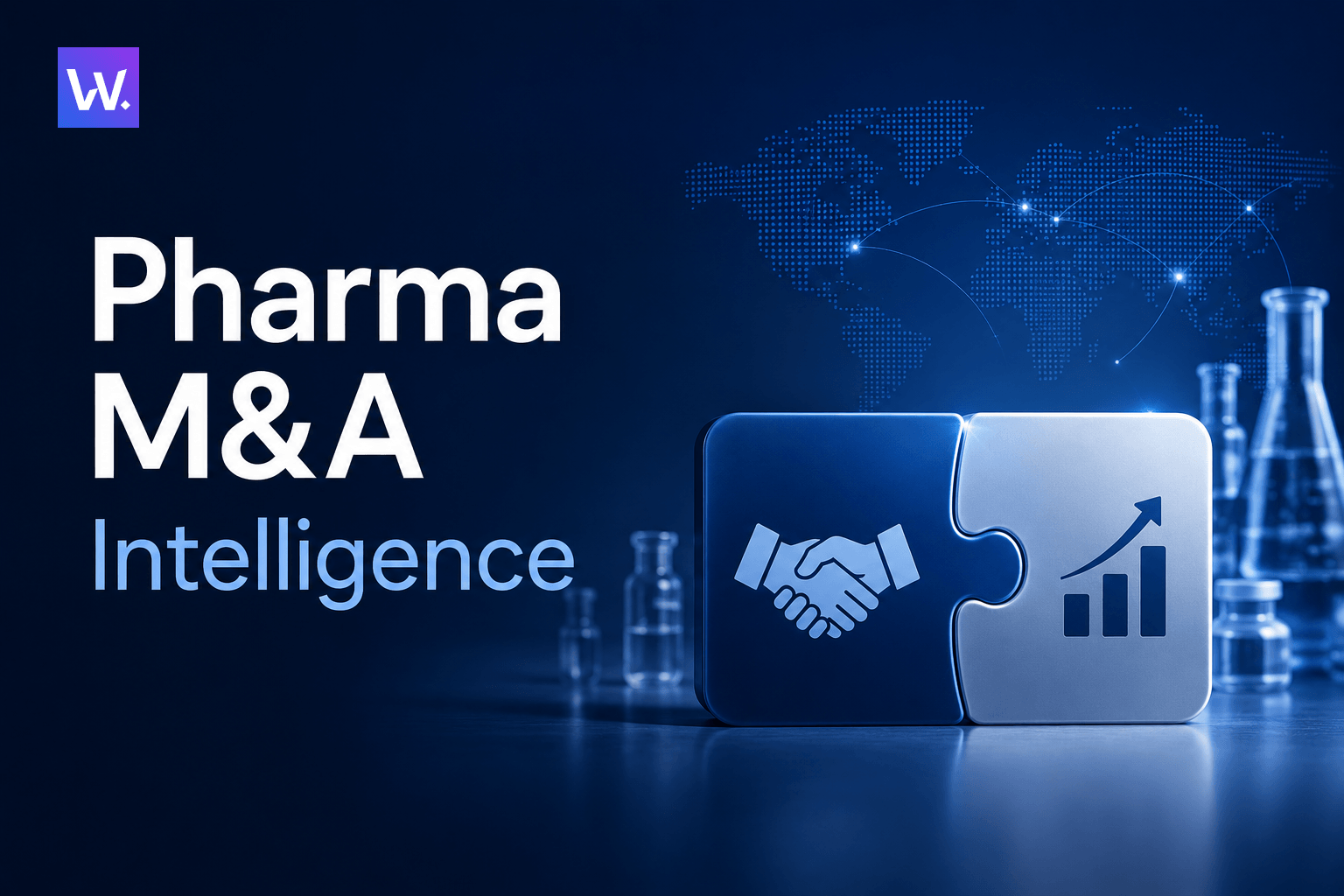
Pharma M&A in 2026 tells a clear story. Large pharmaceutical companies are facing one of the largest patent cliffs in industry history, putting more than $200 billion in annual revenue at risk over the next five years. As a result, business development teams are seeing a surge in acquisition activity across oncology, immunology, metabolic disease, and rare disease.
Unlike previous M&A cycles dominated by mega-mergers, 2026 is characterized by smaller, earlier-stage, and more targeted acquisitions. Buyers are increasingly willing to acquire Phase 1 and Phase 2 assets, platform technologies, and specialized capabilities that can generate future pipeline value.
For BD and corporate strategy teams, understanding these trends is no longer optional. M&A activity has become one of the strongest indicators of where capital is flowing, which technologies are gaining strategic importance, and where competitive pressure will emerge next.
The Problem: Patent Cliffs Are Forcing Pipeline Acquisition
The primary driver behind the current M&A cycle is straightforward: large pharmaceutical companies need pipeline replacement.
Between 2026 and 2030, drugs representing more than $200 billion in annual revenue are expected to lose exclusivity due to patent expirations and biosimilar competition. For many companies, internal R&D efforts alone cannot replace these revenues quickly enough.
Drug development remains a long-term process. The average timeline from IND filing to approval often exceeds a decade. Companies facing major revenue gaps in 2026, 2027, or 2028 cannot afford to wait for early-stage internal programs to mature.
Three pressures are converging simultaneously.
Revenue Urgency
Companies with blockbuster products approaching loss of exclusivity face immediate revenue replacement challenges. This creates intense competition for late-stage and commercially attractive assets.
IRA Pricing Pressure
The Inflation Reduction Act introduces additional pricing pressure through Medicare negotiation mechanisms. This reduces long-term revenue expectations for certain therapies and accelerates the need to secure future growth drivers.
Investor Expectations
Shareholders continue to expect sustainable growth. Companies that fail to demonstrate credible pipeline replacement strategies often face valuation pressure and increased scrutiny from investors.
The result is a market where acquisitions increasingly serve as a strategic necessity rather than an optional growth lever.
What the Evidence Actually Shows
The patent cliff narrative explains why acquisitions are happening. The composition of deals explains how buyer behavior is changing.
Historically, many large pharmaceutical companies preferred acquiring assets after substantial clinical validation. Today, that approach is shifting.
Across oncology, immunology, and metabolic disease, buyers are moving earlier into the development cycle. Rather than waiting for Phase 3 readouts, many companies are acquiring promising Phase 1 and Phase 2 programs.
At the same time, platform technologies are attracting premium valuations.
Companies with differentiated capabilities in antibody-drug conjugates (ADCs), RNA technologies, gene editing, cell therapy, and AI-enabled discovery often command higher acquisition multiples than single-asset companies.
The market is increasingly paying for future optionality rather than current revenue.
Three patterns stand out:
- Earlier-stage acquisitions are increasing.
- Platform technologies are attracting premium valuations.
- Capital is concentrating in a small number of therapeutic areas.
For business development teams, these shifts change both valuation models and sourcing strategies.
The Insight: The 2026 M&A Playbook Has Changed
The current M&A cycle differs from previous cycles in three important ways.
Earlier-Stage Acquisitions
Large pharmaceutical companies are increasingly acquiring Phase 1 and Phase 2 assets instead of waiting for Phase 3 validation.
This allows buyers to secure assets earlier and at lower acquisition costs while maintaining greater influence over development strategy.
Platforms Over Products
Platform capabilities now command significant strategic value.
Organizations with scalable technology platforms often receive stronger acquisition interest than companies built around a single asset.
Examples include:
- ADC platforms
- RNA platforms
- Gene editing technologies
- AI-enabled drug discovery platforms
Therapy Area Concentration
Deal activity is increasingly concentrated in areas where commercial opportunity, scientific validation, and revenue replacement timelines align.
The strongest activity continues to emerge in:
- Oncology
- Immunology
- Metabolic disease
- Rare disease
The most active therapy areas are not necessarily those with the greatest unmet need. They are the areas that best satisfy strategic and financial requirements for buyers.
M&A by Therapy Area
Current deal activity highlights where buyer attention remains strongest.
| Therapy Area | Deal Activity | Typical Acquisition Focus |
|---|---|---|
| Oncology | Highest volume | Phase 2 assets and ADC platforms |
| Immunology | High value deals | Platform acquisitions and lead assets |
| Metabolic Disease | Rapidly growing | GLP-1 and obesity-adjacent programs |
| Rare Disease | Premium valuations | Late-stage and orphan-designated assets |
| Gene & Cell Therapy | Selective activity | Platform acquisitions |
| CNS & Neurology | Moderate activity | Mixed-stage programs |
Oncology continues to lead in deal count, while immunology and metabolic disease often attract some of the highest valuations.
Decision Intelligence: What These Trends Mean for BD Teams
Understanding deal activity is useful. Turning those signals into action creates competitive advantage.
Competition for Oncology Assets Will Remain Intense
Organizations seeking Phase 2 oncology assets should expect aggressive competition and elevated valuation expectations.
Platform Companies Will Continue to Command Premiums
Technology platforms increasingly influence acquisition decisions. Companies with repeatable innovation engines attract strategic interest beyond their lead program.
Secondary Opportunities Will Increase
Every acquisition creates ripple effects.
Programs outside the acquirer’s strategic priorities may become licensing candidates. Existing partnerships may become available. Portfolio rationalization often creates opportunities for proactive BD teams.
Speed Matters More Than Ever
Many attractive targets are identified months before formal sales processes begin.
Organizations that systematically monitor funding rounds, clinical milestones, partnerships, and acquisition activity gain earlier access to potential opportunities.
The Value of Pharma M&A Intelligence
A structured M&A intelligence program provides benefits beyond transaction monitoring.
Better Target Prioritization
Understanding where buyers are investing helps BD teams focus sourcing efforts on the most strategically relevant opportunities.
Stronger Board-Level Narratives
Market data provides external validation for internal strategic decisions and investment recommendations.
Earlier Opportunity Detection
Acquisition activity often signals broader shifts in technology adoption and therapeutic focus.
Teams that identify these shifts early gain a meaningful advantage.
Example: How a Strategy VP Uses M&A Intelligence
Consider a VP of Corporate Strategy at a top-20 pharmaceutical company facing a significant revenue cliff in 2027.
Her team notices three developments:
- Multiple competitors acquire assets in the same therapeutic area.
- A platform company completes a large financing round.
- A recently acquired biotech owns several assets outside the acquirer’s core focus.
Rather than waiting for analyst reports, the team proactively initiates outreach to several targets.
Two months later, those same companies begin appearing in industry coverage.
The difference is not access to information. It is the ability to interpret market signals earlier.
Building a Pharma M&A Intelligence Programme
Many organizations assume M&A intelligence requires a large analyst team.
In reality, most teams can build an effective foundation using publicly available sources.
A practical starting point includes:
- ClinicalTrials.gov monitoring
- Competitor pipeline tracking
- SEC filing alerts
- Industry publications
- Funding and partnership monitoring
- Conference intelligence
As deal activity increases, organizations can expand into dedicated intelligence platforms and premium databases.
The objective is not collecting more information. The objective is identifying meaningful signals before competitors do.
What BD Teams Should Do Within 72 Hours of a Competitor Acquisition
The period immediately following an acquisition announcement is often the most valuable intelligence window.
During the first 72 hours:
- Review the acquisition rationale.
- Analyze acquired pipeline assets.
- Assess overlap with your portfolio.
- Identify potential divestiture candidates.
- Review disclosed valuation metrics.
- Engage relevant industry contacts.
Most organizations remain reactive during this period.
The teams that move quickly often uncover opportunities unavailable weeks later.
Conclusion
Pharma M&A in 2026 is being driven by patent cliff urgency, pricing pressure, and the need for sustainable growth.
The most active buyers are moving earlier into development, placing greater emphasis on platform capabilities, and concentrating investments in a relatively small group of therapeutic areas.
For business development and corporate strategy teams, acquisition activity should be viewed as more than transaction news. It is a strategic signal revealing where capital is flowing, which technologies are gaining importance, and where future competition will emerge.
The organizations that consistently outperform in business development are not necessarily those executing the largest acquisitions. They are the teams that interpret market signals faster, identify opportunities earlier, and engage targets before the rest of the market catches up.
Frequently Asked Questions
❓ What is driving pharma M&A in 2026?
Three forces: the 2026-2030 patent cliff threatening $200B+ in revenue, post-COVID biotech valuation corrections creating affordable targets, and GLP-1 competition pushing every major player to acquire metabolic and obesity-adjacent assets. The cliff alone has pushed deal activity up 35% versus 2022 levels.
❓ Which therapy areas see the most acquisitions?
Oncology leads by deal count (roughly 40% of transactions). By upfront value, GLP-1 / metabolic disease, rare disease with orphan designation, and neuroscience top the list. Rare disease commands premiums because of pricing power, orphan exclusivity, and smaller required trial sizes.
❓ How can BD teams spot upcoming acquisitions early?
Monitor: IND filings and breakthrough therapy requests, unusual conference attendance patterns from large pharma BD heads, changes in clinical trial sponsorship on ClinicalTrials.gov, and SEC Form 13D/G filings showing stake-building. Teams using dedicated CI platforms identify acquisition signals 3-6 months before public announcement.
❓ What happens to pipeline assets after an acquisition?
On average, 30-40% of acquired pipeline assets are divested, out-licensed, or terminated within 24 months. Early-stage assets (Phase 1 and below) face the highest attrition because acquirers prioritise late-stage revenue-stage programmes. Early detection of this intent creates licensing opportunities for other companies.
❓ How long from announcement to deal close?
Mid-size deals (under $5B) typically close in 3-6 months pending FTC/EU antitrust clearance. Large deals (above $10B) take 9-18 months. Deals where the acquirer already holds significant market share in the same indication face the longest reviews.
❓ What should strategy teams do when a competitor is acquired?
Treat it as an intelligence event. Identify: what the acquirer gains, what divested assets become available, and what the competitive gap is in your own space. Competitor acquisitions frequently create licensing opportunities for abandoned assets that other companies can pursue.
Related Topics
About the Author

Hamza
Healthcare Market Research and Business Development Specialist with a strong focus on pharmaceutical, biotech, and life sciences sectors. Experienced in analyzing market trends, competitive landscapes, and growth opportunities to support strategic decision-making. Skilled in transforming complex healthcare data into actionable insights that drive business expansion, partnerships, and revenue growth.
Related Articles
How AI Is Changing Clinical Trial Design in 2025
A CMO reviews a Phase 2 protocol. The team has designed a traditional randomized, double-blind,…
China Biotech Licensing Wave: What It Means for Western BD Teams
In 2023, Chinese biotechs signed over $50 billion in total deal value with Western pharma…
Decentralized Clinical Trials: Benefits, Limitations and When to Use Them
During the pandemic, a Phase 3 trial for a cardiovascular drug shifted from 100% site-based…