


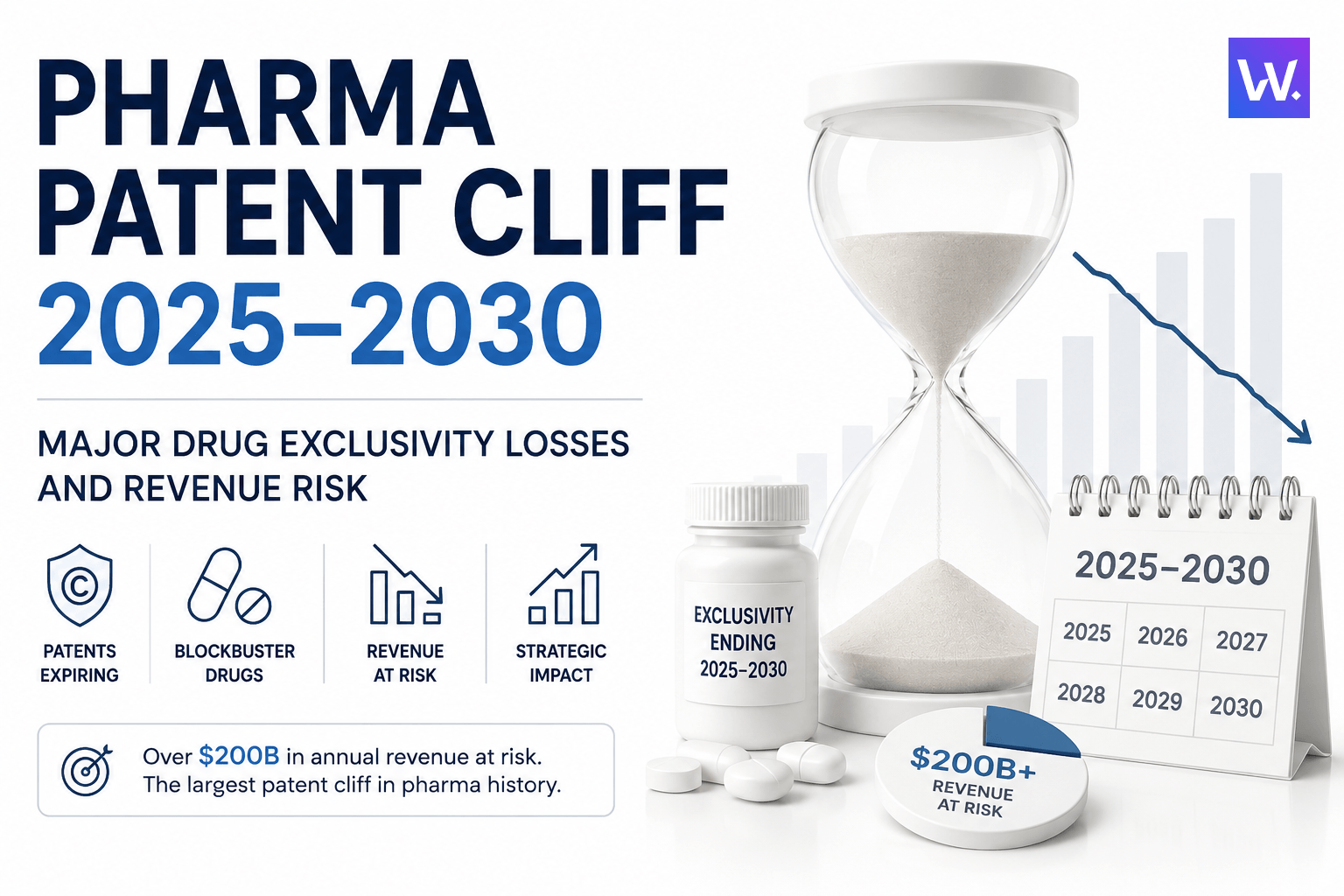
The pharmaceutical industry is entering the largest patent cliff in its history.
Between 2025 and 2030, blockbuster drugs representing more than $200 billion in annual revenue are expected to lose patent protection or face biosimilar competition. For pharmaceutical companies, investors, business development teams, and portfolio analysts, the consequences extend far beyond individual product revenue.
Patent cliffs influence acquisition activity, licensing strategy, pipeline investment, portfolio valuation, and competitive positioning. Understanding which products are exposed, when meaningful competition is likely to arrive, and how revenue erosion unfolds is essential for accurate forecasting and strategic planning.
However, patent expiry does not automatically translate into immediate revenue loss. Factors such as patent estate strength, litigation activity, biosimilar development, physician adoption behavior, and lifecycle management strategies all influence the erosion curve.
For strategy teams, the key question is no longer which patents expire next. The more important question is how those expirations will reshape competitive behavior across the industry.
The Problem: The Largest Patent Cliff in Pharma History
The pharmaceutical industry has experienced major patent cliffs before.
The 2010–2015 period saw several blockbuster products lose exclusivity, including Lipitor and Plavix. Those events significantly reshaped the market and accelerated generic competition across multiple therapeutic areas.
However, the upcoming patent cliff is substantially larger.
Three factors make the 2025–2030 period unique.
Unprecedented Scale
More than $200 billion in annual revenue is expected to face generic or biosimilar competition.
This is roughly two and a half times larger than the previous major patent cliff cycle.
Revenue Concentration
A relatively small number of blockbuster products account for a disproportionate share of exposure.
Several individual drugs generate more than $10 billion annually, meaning a single exclusivity event can materially impact company performance.
Higher Biologic Exposure
Unlike previous cycles dominated by small molecules, many of today’s largest products are biologics.
Because biosimilar competition behaves differently than generic competition, revenue erosion patterns become significantly harder to predict.
What the Evidence Actually Shows
Patent cliffs are often viewed as isolated legal events.
In reality, they are among the strongest predictors of future pharmaceutical strategy.
Companies approaching major exclusivity losses consistently increase business development activity, pursue acquisitions, expand licensing efforts, and accelerate lifecycle management programs.
Historical analysis shows that periods of elevated patent expiry activity often coincide with increased M&A activity and aggressive pipeline acquisition strategies.
This relationship exists because revenue replacement takes years.
A company facing a major exclusivity event in 2028 cannot wait until 2028 to find replacement assets. Strategic decisions must occur several years earlier.
Consequently, patent cliff analysis is not only useful for revenue forecasting. It is also one of the most reliable ways to anticipate future corporate behavior.
For portfolio analysts, understanding the cliff helps estimate revenue risk.
For business development teams, it helps identify future buyers.
For investors, it helps identify companies facing the greatest strategic pressure.
Why Patent Expiry Is Not Revenue Loss
One of the most common mistakes in pharmaceutical forecasting is assuming that revenue declines immediately when a patent expires.
The reality is more complex.
Patent expiry creates the possibility of competition. Revenue erosion occurs only after competitors successfully enter the market.
The timing and severity of erosion vary significantly by product type.
Small Molecules
For traditional small-molecule products, generic entry typically occurs within six to twelve months of exclusivity loss.
Revenue declines are often rapid and severe.
Many products lose 70–90% of branded revenue within two years.
Biologics
Biologics follow a different pattern.
Manufacturing complexity, regulatory requirements, and physician adoption behavior often delay meaningful competition.
As a result, biosimilar erosion tends to be slower and more gradual.
Patent Estate Strength
The depth of a product’s patent estate can significantly alter erosion timelines.
Products protected by multiple formulation, manufacturing, device, and method-of-use patents frequently maintain exclusivity beyond primary patent expiry.
Consequently, accurate forecasting requires a drug-by-drug assessment rather than a simple patent expiration calendar.
Revenue Erosion Expectations by Product Type
| Product Type | Time to Competition | Typical Revenue Erosion After 2 Years |
|---|---|---|
| Small Molecule (Thin Patent Estate) | 6–12 Months | 70–90% |
| Small Molecule (Strong Patent Estate) | 1–3 Years | 40–70% |
| Biologic | 1–3 Years | 30–50% |
| Complex Biologic | 3–5+ Years | 15–30% |
These averages illustrate why patent expiry alone rarely tells the full story.
Major Patent Cliffs Between 2025 and 2030
The following products represent some of the most significant exclusivity events expected during the current cycle.
| Year | Drug | Company | Therapy Area | Revenue Exposure | Type |
|---|---|---|---|---|---|
| 2025 | Eliquis | BMS / Pfizer | Cardiovascular | $20B+ | Small Molecule |
| 2025 | Stelara | Johnson & Johnson | Immunology | $11B | Biologic |
| 2026 | Keytruda | Merck | Oncology | $25B+ | Biologic |
| 2026 | Opdivo | Bristol Myers Squibb | Oncology | $9B | Biologic |
| 2027 | Dupixent | Sanofi / Regeneron | Immunology | $13B | Biologic |
| 2027 | Ozempic / Wegovy | Novo Nordisk | Metabolic Disease | $15B+ | Peptide |
| 2028 | Entresto | Novartis | Cardiovascular | $6B | Small Molecule |
Among these products, Keytruda represents the single largest revenue exposure event.
The scale of its commercial success means that its eventual exclusivity loss will influence strategic decisions across the oncology market.
Decision Intelligence: How to Assess Portfolio Exposure
Patent cliff analysis requires more than identifying expiration dates.
Analysts should evaluate five critical variables.
1. Patent Estate Depth
Understanding every relevant patent provides a more accurate view of effective exclusivity.
2. Paragraph IV Filings
For small molecules, Paragraph IV activity often serves as an early indicator of future generic competition.
3. Biosimilar Development Activity
The number of active biosimilar developers strongly influences future revenue erosion.
4. Physician Switching Behavior
Therapeutic areas differ significantly in biosimilar adoption rates.
Some specialties adopt biosimilars rapidly, while others transition much more slowly.
5. Lifecycle Management Programs
New formulations, combination products, and next-generation therapies can significantly reduce exposure.
The Value of Accurate Patent Cliff Analysis
Organizations that accurately model patent risk gain several advantages.
Better Revenue Forecasting
Revenue exposure can be estimated more accurately when erosion timing is modeled realistically.
Improved Valuation Models
Patent cliff assumptions influence company valuation, acquisition pricing, and investment decisions.
Earlier Competitive Intelligence
Understanding future exclusivity events helps identify strategic shifts before they become public.
Stronger Capital Allocation
Companies can prioritize resources more effectively when future revenue pressure is understood.
How the Patent Cliff Creates M&A Opportunities
Patent cliffs directly influence pharmaceutical acquisition activity.
Companies facing major revenue exposure must replace future cash flows.
In many cases, acquisitions provide the fastest path to pipeline replacement.
As a result, organizations approaching significant patent cliffs often become more aggressive acquirers.
Business development teams can use this information strategically.
By mapping exclusivity timelines against pipeline gaps, it becomes possible to identify likely acquisition targets years before transactions occur.
Patent cliffs therefore function as both revenue signals and business development signals.
Patent Cliff Planning: The 36-Month Commercial Framework
Successful commercial organizations begin planning years before exclusivity loss occurs.
Months 1–12
Focus on maximizing market share through payer contracting, physician engagement, and patient support programs.
Months 13–24
Begin transitioning eligible patients toward successor products and lifecycle extensions.
Months 25–36
Prioritize segments where brand loyalty remains strongest and substitution risk remains lower.
By the time generic or biosimilar competition becomes widespread, most commercial preparation should already be complete.
What the Patent Cliff Means for Pharma BD Priorities
Patent cliffs influence what large pharmaceutical companies are willing to buy.
Organizations facing significant revenue exposure often prioritize:
- Late Phase 2 assets
- Phase 3 programs
- Commercial-stage products
- Platform technologies with multiple future applications
For smaller biotech companies, understanding these priorities creates significant partnering opportunities.
Assets aligned with future revenue replacement needs frequently command stronger valuations and attract greater strategic interest.
Example: Modeling Eliquis Revenue Erosion
A simplistic forecast assumes:
- Patent expiry occurs in 2025.
- Generic entry follows immediately.
- Revenue declines by 80% within two years.
This model suggests approximately $16 billion in exposure.
However, a more realistic analysis produces a different outcome.
Eliquis possesses multiple patents extending beyond the primary patent date. Litigation activity remains active, and settlement outcomes may influence generic entry timing.
In addition, lifecycle management initiatives may preserve portions of the franchise.
A more realistic scenario assumes:
- 40–50% erosion in Year 1
- 60–75% erosion in Year 2
- 80%+ erosion only after Years 3–4
The difference between these models represents billions of dollars in valuation impact.
Related Insights
To better understand the broader strategic implications of patent cliffs, explore:
- Clinical Trial Failure Rates and how development attrition affects pipeline replacement.
- Clinical Trial Intelligence and how operations teams accelerate development timelines.
- Pharma M&A Intelligence and how large pharmaceutical companies respond to future revenue pressure.
Conclusion
The 2025–2030 pharmaceutical patent cliff represents the largest exclusivity challenge the industry has ever faced.
More than $200 billion in annual revenue is expected to face generic or biosimilar competition, with the greatest exposure concentrated between 2025 and 2028.
However, patent expiry alone does not determine commercial impact.
Patent estate depth, biosimilar competition, litigation activity, switching behavior, and lifecycle management strategies all influence the timing and severity of revenue erosion.
For portfolio analysts, investors, business development teams, and strategy leaders, understanding these dynamics provides a significant competitive advantage.
The organizations that navigate this period most successfully will not simply track patent expiration dates.
They will understand how those expiration dates reshape acquisitions, partnerships, competitive positioning, and long-term portfolio strategy.
Frequently Asked Questions
What is the pharma patent cliff?
The pharma patent cliff refers to a period when multiple blockbuster drugs lose patent protection, allowing generic or biosimilar competitors to enter the market and reduce branded product revenue.
Which drugs face the largest exclusivity losses before 2030?
Major products include Keytruda, Eliquis, Stelara, Opdivo, Dupixent, Ozempic, Wegovy, and Entresto. Together, these products represent more than $200 billion in revenue exposure.
What is the difference between patent expiry and data exclusivity?
Patent protection and data exclusivity are separate forms of protection. Data exclusivity prevents competitors from relying on the originator’s clinical data even when patents expire.
How do companies respond to an approaching patent cliff?
Most companies focus on lifecycle management, acquisitions, licensing transactions, and pipeline acceleration strategies to replace future revenue.
Do biosimilars create the same impact as generics?
No. Biosimilars typically produce slower and less severe revenue erosion because physician adoption and payer substitution occur more gradually.
What should commercial teams do before exclusivity loss?
Commercial teams should begin planning approximately three years before expected competition by optimizing payer strategy, strengthening patient retention programs, and preparing lifecycle management initiatives.
Why do patent cliffs increase pharmaceutical M&A activity?
Companies facing significant future revenue declines often acquire late-stage assets and commercial products to replace expected losses and maintain long-term growth.
How can investors assess patent cliff risk?
Investors should evaluate patent estate strength, biosimilar activity, litigation exposure, lifecycle management programs, and pipeline replacement capability rather than relying solely on patent expiry dates.
Related Topics
About the Author

Hamza
Healthcare Market Research and Business Development Specialist with a strong focus on pharmaceutical, biotech, and life sciences sectors. Experienced in analyzing market trends, competitive landscapes, and growth opportunities to support strategic decision-making. Skilled in transforming complex healthcare data into actionable insights that drive business expansion, partnerships, and revenue growth.
Related Articles
How AI Is Changing Clinical Trial Design in 2025
A CMO reviews a Phase 2 protocol. The team has designed a traditional randomized, double-blind,…
China Biotech Licensing Wave: What It Means for Western BD Teams
In 2023, Chinese biotechs signed over $50 billion in total deal value with Western pharma…
Decentralized Clinical Trials: Benefits, Limitations and When to Use Them
During the pandemic, a Phase 3 trial for a cardiovascular drug shifted from 100% site-based…