
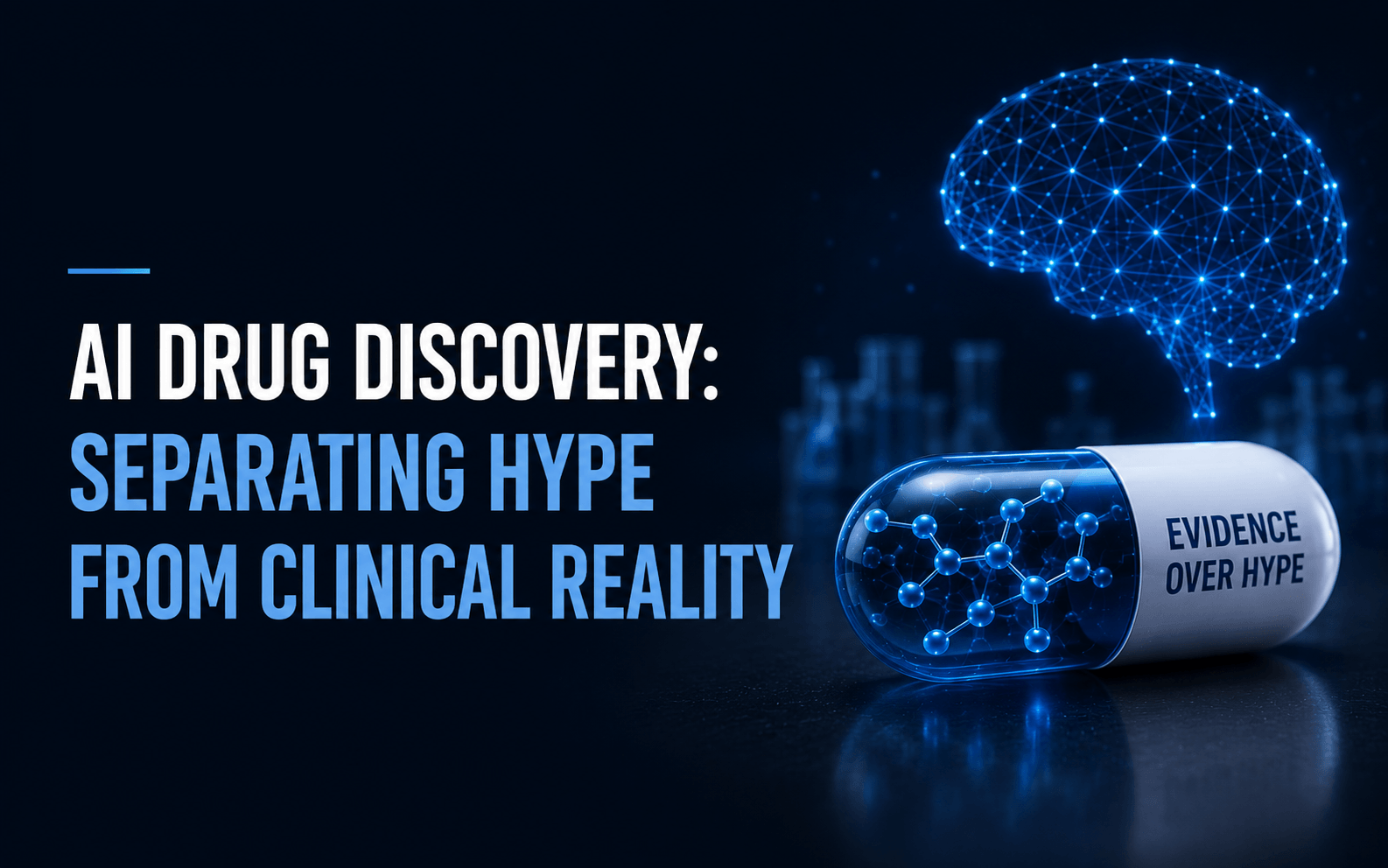
Every major pharma company now has an AI strategy. At least, that is what their press releases say. In 2024 alone, biopharma companies announced over 300 AI-related partnerships and collaborations. Conference stages filled with presentations about generative models, foundation models, and AI-designed molecules.
However, a different picture emerges when you look past the announcements. Only a handful of AI-discovered compounds have reached clinical trials. Fewer still have generated data that changes how scientists think about drug design. The gap between AI marketing and AI reality in drug discovery is wider than most industry coverage admits.
This article separates the real from the aspirational. It maps where AI actually works in drug discovery today, where it shows promise but lacks proof, and where the claims still outpace the evidence. If you are a CSO deciding where to invest R&D resources – or an investor evaluating AI-first biotechs – this distinction matters.
The Problem: AI Claims Outpace Clinical Evidence
The core problem is not that AI does not work in drug discovery. It is that the industry conflates three very different things: academic research, commercial software, and clinical validation.
An academic paper showing that a neural network can predict protein-ligand binding affinity is research. A company selling that model as a drug discovery platform is a product. A drug designed by that model entering Phase 1 trials is evidence. Most AI drug discovery claims live in the first two categories. Very few have reached the third.
AI Drug Discovery: Evidence Pyramid
Fewer than 20 AI-primary clinical candidates
100+ companies selling AI drug discovery
1,000+ published papers
Most AI drug discovery claims live at the base. Clinical validation remains the narrowest tier.
This matters for decision-makers because the risk profile is completely different at each level. Investing in a platform backed by strong academic papers is not the same as investing in a platform that has produced a clinical-stage molecule.
The real insight: The most common mistake CSOs and investors make is evaluating AI drug discovery companies based on their technology instead of their output. A sophisticated model architecture means nothing if it has not produced molecules that survive preclinical testing. As a result, the right question is never “how advanced is the AI?” It is “what has the AI actually produced that a chemist would not have found?”
Where AI Actually Works in Drug Discovery Today
AI in drug discovery is not one technology. It spans at least six distinct application areas, each at a different maturity level. Understanding this map prevents the mistake of treating all AI applications as equally proven or equally speculative.
AI Application Maturity Spectrum (2025)
EXPERIMENTAL
| Application Area | Maturity | What It Does | Evidence Status |
|---|---|---|---|
| Target identification | Production | Uses multi-omics, knowledge graphs to identify disease-relevant targets | Multiple validated targets in clinical programs |
| Literature and data mining | Production | Extracts structured insights from publications, patents, trial data | Widely deployed; time savings well documented |
| ADMET prediction | Advanced | Predicts absorption, distribution, metabolism, excretion, toxicity | Improves screening efficiency; adopted by top 20 pharma |
| Molecular optimization | Intermediate | Suggests structural modifications to improve compound properties | Accelerates lead optimization; clinical evidence emerging |
| De novo molecular design | Early | Generates novel molecular structures from scratch | A few clinical candidates; most still preclinical |
| Clinical outcome prediction | Experimental | Predicts trial success probability | Limited validation; high potential but unproven at scale |
Key takeaway: AI is most reliable where it augments existing scientific workflows – target ID, literature mining, property prediction. It is least proven where it attempts to replace scientific judgment entirely – de novo design, clinical prediction.
What the Evidence Actually Shows
The challenge with evaluating AI in drug discovery is that announcements are far more visible than outcomes. Industry headlines frequently highlight new AI partnerships, platform launches, and molecule-generation breakthroughs, yet relatively few of these initiatives have progressed far enough to demonstrate clinical success.
This does not mean AI has failed. Rather, it means the industry’s evidence base is still maturing.
The strongest evidence today comes from applications that support existing scientific workflows. AI-powered target identification platforms can analyze multi-omics datasets at a scale that would be impractical for human researchers alone. Literature mining systems help scientists process thousands of publications, patents, and clinical records more efficiently. ADMET prediction models improve compound prioritization and reduce unnecessary laboratory testing.
Where evidence becomes less clear is in areas where AI attempts to make highly complex scientific decisions independently. Generative models can create novel molecular structures, but relatively few AI-generated molecules have advanced through clinical development. Similarly, clinical outcome prediction remains an active area of research, with limited proof that current models can consistently predict trial success across therapeutic areas.
What Current Evidence Suggests
- Strong evidence: Target identification, literature mining, and ADMET prediction.
- Growing evidence: Lead optimization and molecular property prediction.
- Emerging evidence: De novo molecular design.
- Limited evidence: Clinical outcome prediction.
The closer AI moves toward supporting scientific decision-making, the stronger the evidence. The closer it moves toward replacing scientific judgment, the more limited the validation becomes.
The key lesson is that AI’s value today comes primarily from acceleration rather than automation. The most successful organizations use AI to help scientists make better decisions faster, not to remove scientists from the discovery process altogether.
The Insight: Why the Hype-Reality Gap Persists
Three structural factors keep the AI drug discovery hype cycle spinning.
Factor 1: Timelines obscure failure. Drug development takes 10-15 years. An AI-discovered compound entering Phase 1 in 2023 will not have efficacy data until 2026 or later. In the meantime, the company can claim “AI-discovered molecule in clinical trials” without anyone being able to verify whether the AI actually made a difference.
Factor 2: Attribution is unclear. Most drug discovery involves hundreds of decisions. AI may have helped identify a target, but a human chemist designed the molecule. Or AI suggested 50 molecular structures, and a medicinal chemist selected and modified the one that advanced. Who gets credit? Companies incentivized to say “AI-discovered” will claim it even when AI played a supporting role.
Factor 3: Publication bias. Academic papers and company press releases report successes. They do not report the thousands of AI predictions that failed during screening. Consequently, the public evidence base is skewed toward positive results, which inflates perceived accuracy.
Three Factors Driving the AI Hype-Reality Gap
Decision Intelligence: How to Evaluate AI Drug Discovery Claims
Whether you are evaluating an AI-first biotech for partnership, considering an AI platform for your R&D team, or briefing your board on AI strategy, five evaluation criteria separate real capability from marketing.
Criterion 1: Clinical output. Has the company’s AI produced a molecule that has entered human trials? If yes, what role did AI play specifically? If no, how close is the most advanced candidate to IND filing?
Criterion 2: Disclosed methodology. Can the company explain, at a technical level, what their AI does differently? Companies with real technology can describe their approach specifically. Companies that only describe outcomes are often wrapping standard methods in AI branding.
Criterion 3: Pharma validation. Has a credible pharma partner adopted the platform for internal programs – not just a press-release collaboration, but an active program with disclosed milestones?
Criterion 4: Published benchmarks. Has the AI been tested against standard benchmarks or, better, against retrospective datasets where the answer is known?
Criterion 5: Team composition. Does the team include experienced drug hunters alongside AI researchers? AI-only teams build better algorithms. Drug-discovery teams with AI skills build better drugs.
| Evaluation Level | Signal | What It Means |
|---|---|---|
| Strong | AI-discovered molecule in Phase 1+ trials | Real clinical output from AI platform |
| Moderate | Active pharma partnerships with disclosed milestones | Credible validation from industry |
| Weak | Publications without clinical candidates | Academic promise, not commercial proof |
| Red flag | Undisclosed methodology, outcome-only marketing | Likely standard methods with AI branding |
The Solution: A Practical Framework for CSOs
Instead of asking “should we use AI?”, the productive question is “where does AI add the most value given our current pipeline and capabilities?”
For target identification: AI is production-ready. If your team spends significant time on target validation using multi-omics data, knowledge graphs, or literature mining, AI tools can accelerate this by 40-60%. This is the safest entry point.
For lead optimization: AI tools that predict ADMET properties and suggest structural modifications are increasingly reliable. They do not replace medicinal chemists. Instead, they reduce the number of compounds that need to be synthesized and tested.
For de novo design: Proceed with caution. If you are considering an AI-first approach to molecular design, demand evidence of molecules that survived preclinical testing. In particular, evaluate whether the company’s claimed novelty actually translates to patentable, synthesizable, and developable molecules.
For clinical prediction: Treat this as a research investment, not a production tool. The models are improving rapidly, but no platform has demonstrated reliable clinical outcome prediction at scale.
The Value: What Real AI Deployment Delivers
When applied to the right problems, AI in drug discovery produces three measurable outcomes.
Faster target identification. Teams using AI-powered knowledge graphs and multi-omics analysis report identifying validated targets 30-50% faster than traditional approaches. At the same time, they evaluate a broader range of potential targets.
Fewer wasted synthesis cycles. AI-powered ADMET prediction helps medicinal chemistry teams prioritize compounds more effectively. Early adopters report 20-30% reductions in the number of compounds synthesized during lead optimization.
Better-informed partnerships. For BD and CSO teams evaluating in-licensing targets, AI-powered pipeline intelligence helps assess the scientific credibility of a target company’s approach.
According to Boston Consulting Group analysis, AI in pharma R&D delivers 25-50% time reduction in early discovery phases for companies with mature AI integration.
Example: Two Biotechs, Two Approaches
Consider two mid-size biotechs, both in oncology, both claiming AI-driven drug discovery.
Company A has a team of 40 – 25 computational scientists and 15 biologists and chemists. Their AI platform generates novel molecular structures using generative models. They have published several papers on molecular generation benchmarks. Their most advanced program is a preclinical candidate. No pharma partnership with disclosed milestones.
Company B has a team of 35 – 10 computational scientists, 15 medicinal chemists, and 10 biologists. Their AI focuses on target identification and lead optimization. They have two molecules in Phase 1 trials. The AI helped identify the targets and accelerated lead optimization, but experienced chemists designed the final molecules. They have an active partnership with a top-10 pharma company with milestone payments.
Which company has a more credible AI story? By the five-criteria framework: Company B. Their AI supports experienced drug hunters and has produced clinical-stage output. Company A has more impressive technology on paper, but their pipeline has not yet validated it.
The lesson is consistent: AI that accelerates human expertise outperforms AI that attempts to replace it – at least in 2025.
Conclusion
AI in drug discovery is real, but not in the way most headlines suggest. The applications delivering measurable value today, target identification, literature mining, and property prediction, are often the least visible. Meanwhile, the most heavily marketed applications, including autonomous molecular design and clinical outcome prediction, still require significantly more validation.
For CSOs, investors, and R&D leaders, the practical lesson is clear: evaluate AI platforms by scientific and clinical output, not by algorithm complexity. Focus on teams that combine computational expertise with proven drug-discovery experience, and prioritize applications that augment existing workflows rather than attempt to replace them.
Five years from now, the winners in AI drug discovery will not be the companies that generated the most headlines. They will be the companies whose molecules reached patients, whose programs advanced through clinical development, and whose science translated into measurable outcomes.
Frequently Asked Questions
What is AI drug discovery?
AI drug discovery uses machine learning, deep learning, and generative AI technologies to identify drug targets, optimize compounds, predict molecular properties, and accelerate pharmaceutical research.
How is AI used in drug discovery today?
AI is commonly used for target identification, literature mining, ADMET prediction, lead optimization, and knowledge graph analysis. These applications help researchers make faster and more informed decisions throughout the drug discovery process.
Can AI design new drugs on its own?
AI can generate novel molecular structures and recommend compound modifications. However, successful drug discovery programs still rely heavily on medicinal chemists, biologists, and pharmacologists to validate and optimize potential drug candidates.
Which AI applications in drug discovery are most proven?
The most validated applications include target identification, literature mining, ADMET prediction, and lead optimization. These areas have demonstrated measurable improvements in efficiency and research productivity.
Is AI drug discovery clinically validated?
Clinical validation remains limited. While several AI-assisted drug candidates have entered human clinical trials, long-term evidence demonstrating widespread clinical success is still emerging.
How should pharma companies evaluate AI drug discovery platforms?
Organizations should assess clinical-stage outputs, methodology transparency, published benchmarks, pharmaceutical partnerships, and the expertise of the scientific team behind the platform.
What are the limitations of AI in drug discovery?
Current limitations include limited clinical validation, data quality challenges, long drug development timelines, attribution difficulties between AI and human contributions, and uncertainty in clinical outcome prediction.
Will AI replace medicinal chemists and drug discovery scientists?
No. Current evidence suggests AI performs best when augmenting scientific expertise rather than replacing experienced drug discovery professionals. The most successful programs combine AI capabilities with deep scientific knowledge.
Related Topics
About the Author

Hamza
Healthcare Market Research and Business Development Specialist with a strong focus on pharmaceutical, biotech, and life sciences sectors. Experienced in analyzing market trends, competitive landscapes, and growth opportunities to support strategic decision-making. Skilled in transforming complex healthcare data into actionable insights that drive business expansion, partnerships, and revenue growth.
Related Articles
How AI Is Changing Clinical Trial Design in 2025
A CMO reviews a Phase 2 protocol. The team has designed a traditional randomized, double-blind,…
China Biotech Licensing Wave: What It Means for Western BD Teams
In 2023, Chinese biotechs signed over $50 billion in total deal value with Western pharma…
Decentralized Clinical Trials: Benefits, Limitations and When to Use Them
During the pandemic, a Phase 3 trial for a cardiovascular drug shifted from 100% site-based…